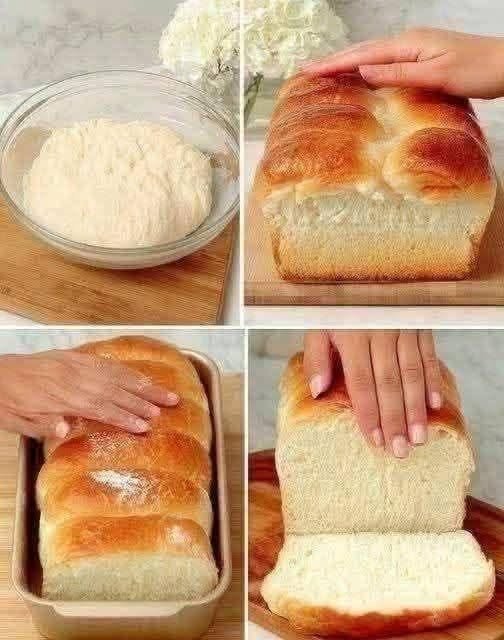
The picture shows soft, fluffy milk bread, similar to Japanese-style milk bread or enriched sandwich bread. It has a golden, shiny crust, a fine white crumb, and a pillowy texture that springs back when gently pressed.
This recipe makes a tender loaf using milk, butter, yeast, and a little sugar. I’ll include the complete measurements, kneading and proofing instructions, nut information, troubleshooting, storage, and frequently asked questions.
Preparation
25–35 minutes
Rising time
1½–2½ hours
Baking
25–35 minutes
Yield
1 large loaf, 10–12 slices
1. Complete ingredients list
A. For the bread dough
Salt Bread: Sejarah, Resipi Shio Pan & Rahsia Hasil Roti Lembut, Gebu Bermentega
500 g bread flour or strong white flour
250 ml lukewarm milk, approximately
50 g granulated sugar
7 g instant yeast (about 2¼ teaspoons)
8 g salt (about 1¼ teaspoons)
1 large egg, about 50 g without shell
50 g unsalted butter, softened
1 teaspoon milk powder, optional
Important: Different flours absorb different amounts of liquid. Start with 230–240 ml milk and add the remainder gradually until the dough is soft and slightly tacky.
B. For the egg wash
1 egg
1 tablespoon milk
Whisk together for a glossy, golden crust. For an egg-free finish, brush the loaf with milk instead.
C. Optional milk-bread tangzhong
Tangzhong is a cooked flour-and-milk paste that helps bread retain moisture and stay soft for longer.
20 g flour, taken from the 500 g total
100 ml milk, taken from the measured milk total
For this method, use 400 g flour in the main dough and reserve 20 g flour for the tangzhong. Use 100 ml milk for the tangzhong and approximately 150 ml milk in the main dough, adjusting as necessary.
My recommendation: Use the tangzhong method if you want exceptionally soft bread that stays tender for several days.
2. Step-by-step recipe
Step 1: Make the tangzhong (optional, but recommended)
Shokupan, la receta paso a paso del irresistible pan de leche japonés
Place 20 g flour and 100 ml milk in a small saucepan.
Whisk until no lumps remain.
Cook over low heat, stirring constantly.
When the mixture becomes a thick paste, remove it from the heat. This usually takes 2–4 minutes.
Transfer it to a small bowl and let it cool until lukewarm.
Do not add hot tangzhong directly to the yeast mixture, as excessive heat can damage the yeast.
Step 2: Mix the dough
Pan de leche: la receta más fácil para conseguir unos panecillos muy esponjosos
Add the flour, sugar, instant yeast, and milk powder to a large mixing bowl.
Add the cooled tangzhong, egg, and most of the remaining milk.
Mix until a rough dough forms.
Add the salt and mix again.
Knead for approximately 5 minutes until the dough starts to become smooth.
Add the softened butter gradually, mixing after each addition.
The dough may look slippery or sticky after adding the butter. Continue kneading rather than adding large amounts of extra flour.
Step 3: Knead until smooth and elastic
Bäcker knetet geschmeidigen Hefeteig in moderner Küche
By hand: Knead for about 12–18 minutes.
With a stand mixer: Knead with a dough hook on low to medium-low speed for about 8–12 minutes.
The dough should become smooth, elastic, and slightly tacky. It should stretch into a thin membrane without tearing immediately when gently tested.
This is often called the windowpane test. It helps you judge gluten development and is one of the keys to fluffy bread.
Avoid adding too much flour during kneading. A stiff dough produces a denser loaf.
Step 4: First rise
Как приготовить крестьянский хлеб, который можно в Великий пост: простой рецепт без молока и яиц
Lightly grease a clean bowl.
Place the dough inside and turn it once so the surface is lightly coated.
Cover the bowl.
Leave it in a warm, draft-free place for approximately 60–90 minutes.
The dough should become roughly twice its original size. The exact time depends on the room temperature and yeast activity.
Do not rely on the clock alone. If your kitchen is cool, the rise may take longer.
Step 5: Shape the loaf
Sourdough Milk Bread Recipe | King Arthur Baking
For the four rounded sections shown in your picture:
Gently press the risen dough to release large air pockets.
Transfer it to a lightly floured work surface.
Divide it into four equal portions.
Shape each portion into a smooth ball, then gently roll it into a short oval.
Flatten each piece slightly and roll it up into a neat log, sealing the seam underneath.
Arrange the four pieces side by side in a lightly greased loaf tin.
A loaf tin around 23 × 13 cm (9 × 5 inches) is a useful starting size for this quantity, although a taller tin may be preferable depending on its capacity.
Step 6: Second rise
Super SD Sandwich Bread Formula & Method | The Fresh Loaf
Cover the tin loosely with greased plastic wrap or a clean towel.
Leave the dough to rise for approximately 30–60 minutes.
Preheat the oven to 175°C (350°F) near the end of proofing.
Wait until the dough has become puffy and expanded noticeably, usually approaching the top of the tin.
Avoid overproofing. Dough that rises too far may collapse in the oven or produce a weak structure.
Step 7: Apply the egg wash
Beat one egg with one tablespoon of milk.
Gently brush a thin layer over the top of the dough.
Avoid pressing down on the soft dough.
For a more matte finish, brush with milk instead.
Step 8: Bake the bread
Food Baking concept Fresh baked organic homemade soft milk loaf bread in loaf pan on wooden board with copy space
Bake at 175°C (350°F) for approximately 25–35 minutes.
Check the loaf after 20 minutes. If the top is browning too quickly, cover it loosely with foil.
The bread should have a golden-brown crust and feel set.
If using a thermometer, the center should generally reach about 90–93°C (194–199°F).
Remove the loaf from the tin after 5–10 minutes and transfer it to a wire rack.
Oven temperatures vary, so use the color and internal temperature as guides rather than relying on time alone.
Step 9: Make the crust extra soft
fresh baked milk bread loaf on rack
For a softer crust, brush the hot loaf lightly with a little melted butter after removing it from the oven.
Let the bread cool for at least 45–60 minutes before slicing. Cutting it while hot can compress the crumb and make the center seem gummy.
The loaf should have a soft, fine crumb that gently springs back when pressed.
3. Nut information and variations
The bread shown in the photograph appears to be plain milk bread. No nuts are necessary for the recipe.
Ingredient
Suggested amount
Effect
Almond flour
20–30 g
Adds a mild nutty flavor but can make the loaf heavier
Chopped walnuts
40–60 g
Adds texture and earthy flavor
Chopped almonds
30–50 g
Adds a light crunch
Sesame seeds
1–2 tbsp
Adds a toasted surface flavor
Sunflower seeds
30–40 g
Adds crunch without using tree nuts
If you want the same soft, plain loaf shown in the picture, skip the nuts and seeds.
Nut allergy precautions
Check flour, milk powder, yeast, and packaged ingredients for cross-contact warnings.
Almonds and walnuts are tree nuts; sesame and sunflower seeds are different ingredients but can also cause allergies.
Do not add nut flour as a direct one-for-one replacement for bread flour, as it does not provide the gluten needed for the same structure.
If baking for someone with a severe allergy, use appropriately labeled ingredients and clean equipment to prevent cross-contact.
4. Frequently asked questions (Q&A)
Q1. Why is my bread not soft and fluffy?
The dough may have been too dry, insufficiently kneaded, underproofed, or overbaked. Measure the flour by weight, add milk gradually, knead until elastic, and avoid leaving the loaf in the oven longer than necessary.
Q2. Can I make this bread without eggs?
Yes. Omit the egg and add approximately 30–40 ml additional milk as needed. The loaf may be slightly less rich, but the tangzhong method helps retain softness. Brush with milk before baking.
Q3. Can I use all-purpose flour instead of bread flour?
Yes. All-purpose flour works well, although the loaf may be a little less chewy and structured. Start with slightly less milk and adjust according to the dough.
Q4. Can I use active dry yeast?
Yes. Use 7–8 g active dry yeast. If the package instructions recommend activation, dissolve it in some of the lukewarm milk with a little of the sugar and allow it to foam before mixing. Do not use hot milk.
Q5. Why is my dough sticky?
Enriched dough is naturally soft and can feel sticky, especially after adding butter. Knead it longer before adding extra flour. Lightly greasing your hands or work surface can make handling easier.
Q6. Why did my loaf collapse after baking?
Common causes include overproofing, insufficient gluten development, too much liquid, or removing the bread before it is fully baked. Allow the dough to rise until puffy rather than waiting for it to become extremely large.
Q7. Can I make the bread without tangzhong?
Yes. Omit the tangzhong and use the full 500 g flour with approximately 250 ml milk, adjusting the amount as needed. The bread will still be soft, but it may dry out a little faster.
Q8. Can I make the dough the night before?
Yes. After kneading, place the covered dough in the refrigerator for its first rise. Refrigerate overnight, ideally in a bowl large enough to allow expansion. The next day, let it warm slightly, shape it, complete the final proof, and bake.
Q9. How do I get the shiny golden crust?
Brush the dough gently with egg wash before baking. A light coating of melted butter after baking also adds shine and softness.
Q10. Can I make this in Pakistan?
Yes. Use maida or strong white flour, full-fat milk, unsalted butter, instant yeast, and cheeni. If your maida absorbs less liquid than expected, hold back some milk initially and add it gradually.
Q11. How should I store the bread?
Once completely cool, store it in an airtight bag or container at room temperature for about 2–3 days. Avoid refrigerating it because refrigeration can make bread stale faster.
Q12. Can I freeze the loaf?
Yes. Cool it completely, wrap it tightly, and freeze for up to about 2–3 months for best quality. Thaw at room temperature while wrapped to help prevent drying.
Q13. Can I make this recipe in a bread machine?
Usually, yes. Follow your machine’s recommended ingredient order and choose a soft or basic white-bread program. Add the butter according to the machine instructions and check the dough during the first kneading cycle.
Q14. Why is the inside gummy?
The loaf may be underbaked, sliced while hot, or made with too much liquid. Bake until the center reaches the recommended temperature, and let the bread cool fully before cutting.
Q15. Can I use oil instead of butter?
Yes. Use approximately 40 g neutral vegetable oil instead of 50 g butter. The bread will still be soft, although butter gives a richer flavor and aroma.
5. Troubleshooting guide
Problem
Likely cause
What to do
Dense loaf
Poor kneading or underproofing
Knead until elastic and allow enough rise time
Dry crumb
Too much flour or overbaking
Weigh flour and check the loaf earlier
Dough will not rise
Inactive yeast or cold conditions
Check yeast freshness and move dough to a warmer spot
Crust too dark
Oven too hot or too much egg wash
Reduce temperature slightly or cover loosely with foil
Bread shrinks after baking
Overproofing or underbaking
Shorten final proof and bake fully
Dough tears easily
Gluten not developed enough
Knead longer and allow a short rest
Loaf sticks to tin
Tin not greased adequately
Grease well or line with baking paper
6. Nutrition information
Approximate values for one loaf made with the main ingredients, cut into 12 slices:
Nutrient
Per slice
Calories
200–230 kcal
Carbohydrates
32–36 g
Protein
5–7 g
Fat
5–7 g
Sugar
4–6 g
Fiber
1–2 g
These are estimates and vary with flour, milk, butter, egg size, and slice thickness.
7. Printable recipe card
Soft Homemade Milk Bread
One large loaf • 10–12 slices • Oven-baked
Ingredients
500 g bread flour
230–250 ml milk, approximately
50 g sugar
7 g instant yeast
8 g salt
1 egg
50 g softened butter
Optional tangzhong: 20 g flour + 100 ml milk, taken from the total quantities
Egg wash: 1 egg + 1 tbsp milk
Instructions
Prepare and cool the tangzhong, if using.
Mix the flour, sugar, yeast, milk, egg, and tangzhong. Add salt.
Knead until smooth, then knead in the butter.
Cover and let rise until approximately doubled, usually 60–90 minutes.
Divide into four portions, shape, and arrange in a greased loaf tin.
Proof until puffy, about 30–60 minutes.
Brush with egg wash and bake at 175°C (350°F) for 25–35 minutes.
Brush with butter if desired, cool completely, and slice.
Key success tips: Keep the dough soft, knead thoroughly, avoid overproofing, and allow the loaf to cool before slicing.

With years of experience in restaurant research and local SEO, Sara creates accurate, user-friendly guides that work for both people and search engines. Her goal is to help users go from search results to their nearest restaurant or menu choice with as few clicks as possible.
- Hearty Lentil, Potato & Spinach Soup - October 28, 2026
- Creamy White Chicken Chili - October 28, 2026
- Crock Pot Beefy Potato Taco Casserole - October 28, 2026