remaining 1 cup water
½ cup milk
2 tbsp butter
remaining sugar
Warm until comfortably hot but not boiling.
For instant/RapidRise yeast, Fleischmann’s specifies about 120–130°F / 49–54°C.
F
Fleischmann’s
3. Make the dough
In a large bowl combine:
about 2 cups flour
sugar
yeast
salt
Add the warm liquid mixture.
Mix thoroughly.
Add another 1 cup flour and continue mixing.
Then gradually add the remaining flour until you have a soft dough.
What should the dough feel like?
It should be:
soft
slightly tacky
elastic
not runny
not hard or dry
Don’t automatically add all 6 cups of flour. Start with the lower amount and add more only when necessary.
4. Knead
Turn the dough onto a lightly floured surface.
Knead for approximately 8–10 minutes.
You’re looking for dough that becomes:
smooth
elastic
supple
slightly tacky but manageable
A stand mixer can also be used.
Windowpane test
Take a small piece of dough and stretch it gently.
If you can stretch it thin enough for light to pass through without immediately tearing, the gluten is sufficiently developed.
5. First rise
Lightly grease a large bowl.
Put the dough inside and turn it once so the surface gets lightly coated.
Cover with a clean towel or plastic wrap.
Place somewhere warm and draft-free.
Let rise for approximately 45–60 minutes, or until roughly doubled.
F
Fleischmann’s
Don’t rely only on the clock
Temperature affects yeast considerably.
The dough is ready when it has visibly expanded to about twice its original volume.
6. Divide
Gently press the dough down to remove excess gas.
Divide it into 2 equal pieces.
For particularly even loaves, weigh the entire dough and divide the weight by two.
7. Shape the loaves
For each piece:
Roll it into approximately a 12 × 7-inch rectangle.
Starting from the short end, roll it tightly like a jelly roll.
Press out large air pockets as you roll.
Pinch the final seam closed.
Pinch the ends closed.
Put it seam-side down into a greased 8½ × 4½-inch loaf pan.
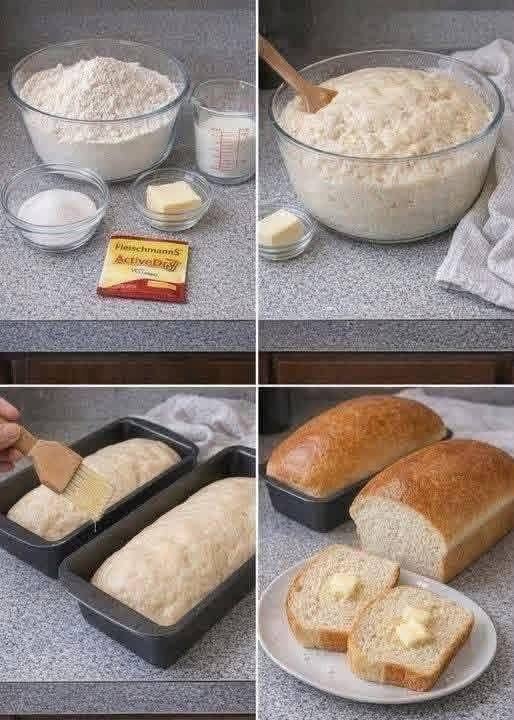
This tight rolling is important for getting the even sandwich-bread crumb seen in your photo.
F
Fleischmann’s
8. Second rise
Cover both pans.
Leave them in a warm, draft-free place for approximately 45 minutes, or until the dough has approximately doubled and is nicely domed.
Don’t let it rise excessively.
If you press the dough gently with a fingertip, the indentation should slowly spring back.
9. Bake
Preheat the oven to:
400°F / 205°C
Bake for approximately:
25–30 minutes
The finished loaves should be nicely golden brown.
Fleischmann’s specifies 400°F for 25–30 minutes.
F
Fleischmann’s
For an especially reliable test, the center of properly baked bread is around 190°F / 88°C.
U
Umami
10. Finish
Immediately remove the loaves from their pans.
Place them on a wire rack.
For the soft, shiny crust shown in your picture, brush the hot tops with a little melted butter.
Allow them to cool before slicing.
Don’t cut immediately!
Hot bread is still setting internally. Cutting too soon can make the crumb gummy or cause it to compress.
Wait at least 45–60 minutes, preferably until completely cool.
Expected Result
You should get:
2 medium sandwich loaves
soft, fluffy interior
fine, even crumb
lightly sweet flavor
tender golden crust
good structure for sandwiches
excellent toast
The recipe is essentially the classic Fleischmann’s formula, which specifically yields two loaves.
F
Fleischmann’s
Nutrition Information
Nutrition varies with the exact amount of flour and the size of your slices. A published nutrition calculation for this same Fleischmann’s recipe gives approximately 244 calories per serving, with 47.4 g carbohydrate, 2.8 g fat, 6.3 g protein, 1.5 g fiber, 3.8 g sugar and 393 mg sodium.
S
Savory Online
Approximate per serving
Calories: 244 kcal
Carbohydrates: 47.4 g
Protein: 6.3 g
Fat: 2.8 g
Saturated fat: 1.5 g
Fiber: 1.5 g
Sugar: 3.8 g
Sodium: 393 mg
Cholesterol: 6 mg
These numbers are recipe-source estimates, not laboratory analysis, and will change with flour brand, milk, butter, slice size and the amount of flour actually used.
Recipe Q&A
Can I use bread flour instead of all-purpose flour?
Yes. Bread flour generally gives a somewhat chewier, stronger loaf. All-purpose flour gives a softer, classic sandwich-bread texture.
Can I use only milk?
You can, but the recipe shown uses water + milk. Using milk for all the liquid will produce a richer, softer loaf.
Can I use only water?
Yes. The bread will still work, although it won’t have quite the same tenderness and flavor contributed by milk.
Can I use active dry yeast?
Yes. Activate it first in warm water as described above. Fleischmann’s provides separate procedures for active-dry and instant/RapidRise yeast.
F
Fleischmann’s
Can I use instant yeast?
Yes. Mix it directly with the dry ingredients and use the appropriate warm liquid method.
Why didn’t my bread rise?
Common causes include:
yeast was old or inactive
liquid was too hot
kitchen was too cold
too much flour was added
dough wasn’t kneaded sufficiently
dough was allowed to rise in a very cold location
Why is my bread dense?
Usually one or more of:
too much flour + insufficient kneading + insufficient proofing.
The dough should remain soft rather than becoming a stiff ball.
Why did the bread collapse?
It may have been over-proofed. If the dough rises dramatically and then collapses during baking, try shortening the second rise.
Why is my crust hard?
Try brushing the hot loaf with butter immediately after baking and avoid overbaking.
Why did my bread crack on the side?
Usually the dough needed more proofing, or the loaf was shaped too tightly/unevenly.
Can I make one loaf?
Yes. Simply halve every ingredient and use one approximately 8½ × 4½-inch pan.
Can I make this whole-wheat?
Yes. Fleischmann’s suggests replacing 2 cups of the all-purpose flour with whole-wheat flour.
F
Fleischmann’s
For a softer whole-wheat loaf, you can replace only part of the white flour rather than all of it.
Can I add an egg?
Yes, but that changes the formula. An egg makes the loaf richer and slightly more tender; compensate for the additional liquid if you substantially alter the recipe.
Can I make it without butter?
Yes. The published recipe permits butter or margarine, and similar sandwich-bread formulas also use vegetable oil.
F
Fleischmann’s
+1
How should I store it?
Once completely cool, keep it tightly wrapped or in an airtight bread bag at room temperature.
For longer storage, freeze the loaf. Slice it before freezing if you want to take out individual slices.
How long does homemade bread last?
For best quality, use it within about 2–3 days at room temperature. Freezing is preferable for longer storage.
My practical tips for getting the exact look in your photo
Weigh the flour if possible.
Don’t force all 6 cups of flour into the dough.
Keep the dough soft and slightly tacky.
Knead until genuinely elastic.
Roll the dough tightly when shaping.
Don’t over-proof the second rise.
Bake at 400°F / 205°C.
Brush the hot loaves with butter.
Cool completely before slicing.
Use a serrated bread knife for clean slices.
Important note: The photo itself doesn’t show the quantities clearly enough to establish an exact recipe from the image alone. The measurements above are the documented

With years of experience in restaurant research and local SEO, Sara creates accurate, user-friendly guides that work for both people and search engines. Her goal is to help users go from search results to their nearest restaurant or menu choice with as few clicks as possible.
- Stuffed Cabbage Rolls - October 18, 2026
- Easy Crockpot Creamy Garlic Parmesan Chicken - October 18, 2026
- Turmeric Carrot Lentil Stew - October 18, 2026