Makes: 1 large loaf or 2 small loaves
Prep: 25–30 minutes
First rise: 8–16 hours
Second rise: 45–75 minutes
Bake: 40–50 minutes
Difficulty: Easy
Style: Rustic, soft inside, crunchy outside
Ingredients
Main dough
Ingredient Amount
Bread flour 300 g
Whole-wheat flour 150 g
Rolled oats 50 g
Instant yeast 4 g / about 1¼ tsp
Salt 9 g / 1½ tsp
Honey or maple syrup 20 g / 1 tbsp
Olive oil 20 g / 1½ tbsp
Warm water 350–370 g
Apple cider vinegar 1 tsp, optional
Seed mixture
Use 100–120 g total seeds:
Sunflower seeds — 30 g
Pumpkin seeds/pepitas — 25 g
Flaxseed — 20 g
Sesame seeds — 15 g
Chia seeds — 10 g
Poppy seeds — 5 g
Hemp hearts — 5–10 g
You don’t have to use every seed. A mixture of sunflower, pumpkin, flax and sesame alone works very well. Seed-heavy bread formulas commonly use combinations such as flax, sunflower and sesame, while other formulas add pumpkin, chia and poppy seeds.
K
King Arthur Baking
+1
Optional nut addition
For a nuttier loaf, add 40–60 g total:
Chopped walnuts — 25 g
Chopped almonds — 20 g
Pecans — 15 g
Important: nuts are completely optional. The bread in the photograph can be made 100% nut-free using seeds only.
1. Prepare the seeds
Put the following into a bowl:
20 g flaxseed
10 g chia
25 g pumpkin seeds
30 g sunflower seeds
15 g sesame
Pour 100 ml boiling water over them.
Mix well and leave for 20–30 minutes.
This is particularly useful for flax and chia because they absorb water and form a gel. Soaking also helps prevent the seeds from making the finished bread dry. Seed-and-grain bread formulas commonly use a hot-water soaker for this purpose.
K
King Arthur Baking Store
+1
Let the mixture cool to room temperature before adding it to the dough.
2. Mix the dough
In a large bowl combine:
300 g bread flour
150 g whole-wheat flour
50 g oats
4 g instant yeast
9 g salt
Mix.
Add:
20 g honey/maple syrup
20 g olive oil
350 g warm water
optional 1 tsp vinegar
cooled seed mixture
Mix with a wooden spoon or dough scraper.
The dough should be sticky and soft, not dry.
If it looks extremely stiff, add another 10–20 g water.
Don’t keep adding flour just because the dough is sticky. A hydrated dough is desirable for this style of bread.
3. First rise
Cover the bowl tightly.
Leave at room temperature for approximately:
8–12 hours for a warm kitchen
12–16 hours for a cooler kitchen
The dough should become noticeably larger, bubbly and airy.
An overnight rise is a standard approach for no-knead bread.
K
King Arthur Baking
Faster version
If you don’t want an overnight rise:
use 7 g instant yeast
allow approximately 1½–2½ hours at warm room temperature.
4. Shape
Dust your counter lightly with flour.
Turn the dough out.
Don’t aggressively knead it.
Fold the dough:
Left side toward the center.
Right side toward the center.
Bottom toward the center.
Top toward the center.
Turn it over so the seam is underneath.
Shape into a round loaf.
For two smaller loaves, divide the dough into two equal pieces first.
5. Add the beautiful seed crust
Mix:
1 tbsp sunflower seeds
1 tbsp pumpkin seeds
1 tbsp sesame seeds
1 tsp flaxseed
1 tsp poppy seeds
Lightly wet the surface of the shaped dough.
Roll the top of the dough through the seeds.
Alternatively, sprinkle the seeds generously over the wet surface and gently press them in.
Using a damp surface to attach seeds to bread is a standard bread-baking technique.
K
King Arthur Baking
6. Second rise
Place the shaped loaf on parchment paper.
Cover loosely.
Allow it to rise for approximately 45–75 minutes.
It doesn’t necessarily need to double.
You want it to look:
puffy
lighter
slightly expanded
soft when gently pressed
7. Bake
Dutch oven method — recommended
Place a Dutch oven with its lid in the oven.
Preheat to:
240°C / 465°F
Heat for approximately 30 minutes.
Carefully place the dough inside.
Score the top with a sharp knife or bread lame.
Cover.
Bake:
20 minutes covered at 240°C / 465°F
Then remove the lid.
Reduce to:
220°C / 425°F
Bake another 20–25 minutes.
The bread should be deep golden brown.
Regular oven method
Place the loaf on a baking sheet.
Preheat to 230°C / 450°F.
Put a heatproof pan on the bottom rack.
When the bread goes into the oven, carefully add approximately 1 cup hot water to the pan to create steam.
Bake approximately:
20 minutes at 230°C / 450°F
then
20–25 minutes at 210–220°C / 410–425°F.
Steam helps with oven spring and crust development.
K
King Arthur Baking
8. Cool — VERY IMPORTANT
Remove the bread from the pan.
Put it on a wire rack.
Wait at least:
1 hour
before slicing.
For the best crumb, wait 2 hours.
If you cut it while extremely hot, the inside can become gummy even though the crust looks perfectly baked.
Complete nut & seed guide
Sunflower seeds
Flavor: mild, buttery
Texture: crunchy
Amount: 20–40 g
Excellent in both the dough and crust.
Pumpkin seeds / pepitas
Flavor: rich and nutty
Texture: substantial crunch
Amount: 20–40 g
Use shelled pepitas.
Flaxseed
Flavor: earthy, nutty
Amount: 10–25 g
Whole flax gives visible seeds; ground flax produces a softer, more integrated texture.
Because flax absorbs water, don’t dramatically increase the quantity without increasing hydration.
Sesame seeds
Flavor: distinctly nutty
Amount: 10–25 g
White, black or a mixture works.
Chia
Flavor: mild
Effect: absorbs a lot of water and creates gel
Amount: 5–15 g
Don’t use huge quantities unless you deliberately increase the water.
Hemp hearts
Flavor: soft, nutty
Amount: 5–20 g
They are softer than sunflower or pumpkin seeds.
Walnuts
Flavor: rich and buttery
Amount: 25–50 g
Chop fairly small.
Almonds
Flavor: sweet and crunchy
Amount: 20–50 g
Sliced or chopped almonds work particularly well on the crust.
Pecans
Flavor: sweet and rich
Amount: 20–50 g
Especially good with maple syrup.
If you have a nut allergy
Make the bread completely nut-free.
Use:
Sunflower + pumpkin + sesame + flax + chia
instead of walnuts, almonds or pecans.
Also check packaged seeds for cross-contact warnings if the bread is being prepared for someone with a serious tree-nut or peanut allergy.
My recommended seed combination
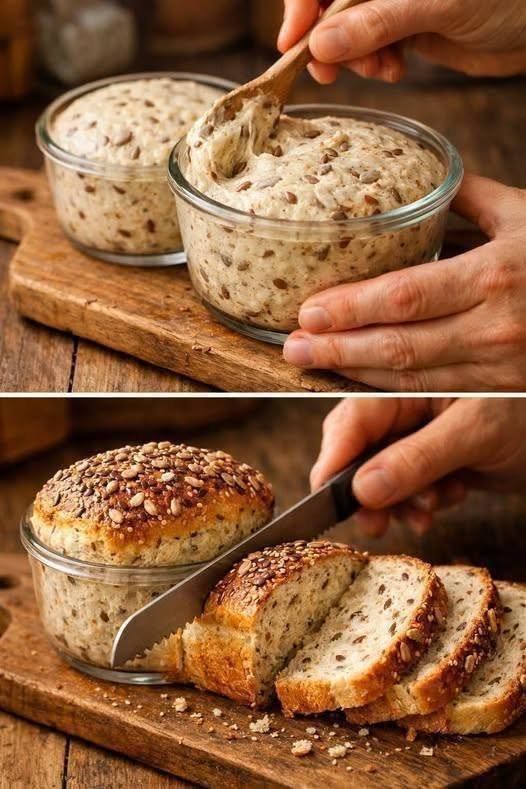
For a loaf closest to the appearance in your photograph:
Inside
30 g sunflower
25 g pumpkin
20 g flax
15 g sesame
10 g chia
Outside
20 g sunflower
20 g pumpkin
15 g sesame
5 g flax
5 g poppy
This gives you a very attractive dark, crunchy seed coating while keeping the inside soft.
Q&A
Q: Can I use all-purpose flour?
Yes. Bread flour gives more chew and structure, but all-purpose flour works.
If using weaker all-purpose flour, start with 340–350 g water rather than the full amount.
Q: Can I use 100% whole-wheat flour?
Yes, but the bread will be substantially denser.
For a lighter loaf, keep at least 50–60% bread/all-purpose flour.
Q: Can I replace honey?
Yes.
Use:
maple syrup
brown sugar
date syrup
or simply omit it.
Q: Can I make it vegan?
Yes.
Use maple syrup instead of honey.
Q: Can I add raisins?
Yes. Add 50–75 g raisins.
For a savory loaf, leave them out.
Q: Can I add cheese?
Yes.
Try:
50–75 g grated cheddar
50 g Parmesan
75 g feta, crumbled
Reduce the salt slightly if the cheese is salty.
Q: Why is my bread dense?
Common causes:
Yeast is old.
Dough didn’t ferment sufficiently.
Too much flour was added.
Kitchen was cold.
Too many seeds/nuts were added.
Dough was overworked with whole-wheat flour.
Bread was sliced while still hot.
Q: Why is my dough extremely sticky?
That’s normal to a point.
Wet your hands rather than adding lots of flour.
If it is literally batter-like, add flour 1 tablespoon at a time.
Q: Why did my seeds fall off?
The outside needs moisture.
Brush the loaf lightly with water before applying seeds and gently press them into the surface.
Q: Can I toast the seeds first?
Yes — and it gives excellent flavor.
Toast sunflower, pumpkin and sesame seeds in a dry pan over medium-low heat for a few minutes.
Cool completely before adding them to the dough.
Don’t aggressively toast flax or chia.
Q: Can I put the dough in the glass containers shown in the picture?
For proofing, yes, provided the containers are suitable for food storage and large enough for expansion.
For baking, only use glass explicitly labeled by its manufacturer as oven-safe for the temperatures you’re using.
Do not assume an ordinary glass jar is oven-safe. Thermal shock can cause glass to shatter.
Q: Can I bake this in a loaf pan?
Yes.
Use approximately 23 × 13 cm / 9 × 5 inch loaf pan.
After shaping, put the dough into the greased pan, allow it to rise until puffy, then bake around 190–200°C / 375–400°F for 40–50 minutes.
Q: How do I know it’s fully baked?
The loaf should be deeply browned and feel hollow when tapped.
If you have a thermometer, aim for roughly 93–96°C / 200–205°F in the center.
Q: How should I store it?
Cool completely first.
Then store in a bread bag or wrapped container at room temperature for approximately 2–3 days.
For longer storage, slice and freeze.
Q: Can I freeze slices?
Absolutely.
Slice the completely cooled bread, place parchment between slices if desired, and freeze in an airtight freezer bag.
Take out individual slices and toast directly from frozen.
Q: Is this a “healthy bread”?
It can be a nutrient-dense bread because it combines whole wheat, oats and seeds, but “healthy” depends on the person’s overall diet and nutritional needs. The seeds add fiber, unsaturated fats, protein and minerals, while the bread still contains substantial carbohydrate and calories.
Q: How can I make it higher in protein?
Add:
20–30 g hemp hearts
20–30 g pumpkin seeds
20–30 g sunflower seeds
You can also replace part of the whole-wheat flour with a higher-protein flour, but avoid dramatically increasing seeds without adjusting hydration.
Q: How can I make the crust extra crunchy?
Use plenty of seeds on the exterior and bake with steam initially, then finish uncovered. Allow the loaf to cool completely on a rack. Steam is also used in professional bread formulas to improve crust development.
K
King Arthur Baking
Q: How can I make the inside softer like sandwich bread?
Add:
25 g olive oil
20–30 g honey
20–30 g milk powder, optional
And bake in a loaf pan rather than as a free-standing boule.
Quick formula to remember
450 g flour + 100–120 g seeds + ~350–370 g water + 4 g yeast + 9 g salt + 20 g oil + 20 g honey
That’s the basic framework.
For the closest visual result to your photograph, I’d use the overnight fermentation + sunflower/pumpkin/sesame/flax/chia mixture + heavy seed coating + Dutch oven method.

With years of experience in restaurant research and local SEO, Sara creates accurate, user-friendly guides that work for both people and search engines. Her goal is to help users go from search results to their nearest restaurant or menu choice with as few clicks as possible.
- Creamy Garlic Parmesan Chicken & Broccoli Rice Bowls - September 19, 2026
- Crispy Cheesy Hashbrowns - September 19, 2026
- Crispy Potato Pockets Snack - September 19, 2026