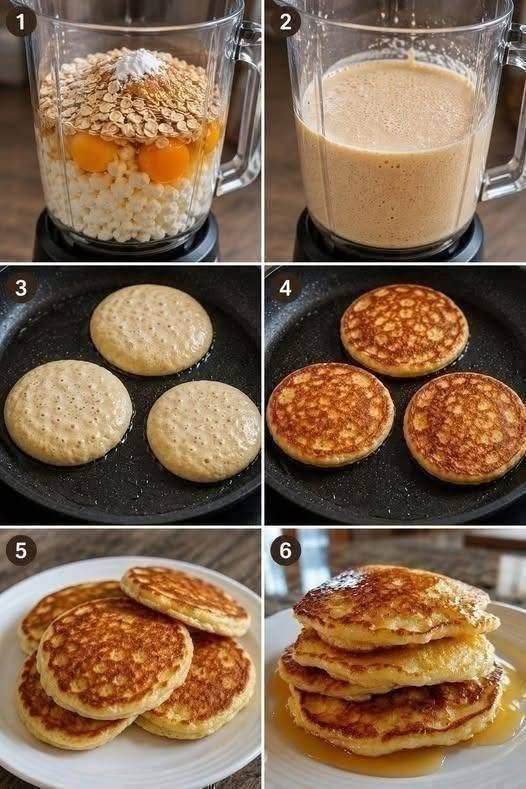
The pictures show a high-protein oat and cottage-cheese pancake: oats, cottage cheese, eggs and a little leavening are blended together, then cooked until golden. This style is well established as a flourless blender pancake, and blending the cottage cheese gives a smooth batter.
E
Eat the Gains
+1
Ingredients — makes about 8–10 pancakes
Pancake batter
1 cup (100 g) rolled/old-fashioned oats
1 cup (220–225 g) cottage cheese
2 large eggs
2 teaspoons baking powder
2 teaspoons ground cinnamon
2 teaspoons vanilla extract
Pinch of salt
2–4 tablespoons milk, only if needed to loosen the batter
For cooking
1–2 teaspoons butter, ghee, or neutral oil
Optional
1–2 tablespoons honey or maple syrup in the batter
½ mashed banana for extra sweetness
1 tablespoon chia or ground flaxseed
Blueberries or chopped strawberries
A little lemon zest
The basic combination of oats, cottage cheese and eggs is also used in simpler three-ingredient versions; baking powder and flavorings make the pancakes more airy and dessert-like.
K
Kitchn
+1 Full Step-by-Step Recipe
1. Add everything to the blender
For easiest blending, put the ingredients into the blender in roughly this order:
Cottage cheese
Eggs
Vanilla
Oats
Baking powder
Cinnamon
Salt
Blend for 30–45 seconds, stopping once to scrape the sides if necessary.
You want a thick, smooth batter. A few tiny oat pieces are perfectly fine.
2. Rest the batter
Let it sit for 5–10 minutes.
This is an important step because the oats absorb moisture and the batter thickens.
S
Sip The Soup
+1
If it becomes too thick to pour, add milk 1 tablespoon at a time.
3. Heat the pan
Place a non-stick skillet over medium-low to medium heat.
Lightly grease with butter or oil.
Don’t use very high heat—the cottage cheese and eggs can brown quickly while the center is still uncooked.
4. Make the pancakes
Pour approximately ¼ cup batter per pancake for larger pancakes, or 2 tablespoons for small pancakes.
Leave space between them.
Cook for approximately 2–3 minutes.
Look for:
edges becoming set
small bubbles/holes appearing
underside becoming golden brown
pancake becoming easy to lift with a spatula
5. Flip
Carefully slide a thin spatula underneath and flip.
Cook another 1–2 minutes until golden brown and cooked through.
The exact cooking time depends on pancake size and pan temperature. Similar blender versions use roughly 2–3 minutes on the first side and 1–2 minutes after flipping.
K
Kitchn
+1
6. Serve
Stack the pancakes and serve immediately.
Excellent toppings:
Classic
Maple syrup
Honey
Butter
Cinnamon
Fruit
Strawberries
Blueberries
Banana
Raspberries
High-protein
Greek yogurt
Extra cottage cheese
Peanut/almond butter
Dessert-style
Dark chocolate chips
Banana + peanut butter
Berries + yogurt + maple syrup
For the stack shown in your picture, butter + maple syrup/honey would give that glossy finish.
Approximate Nutrition
Using 1 cup cottage cheese + 1 cup oats + 2 eggs, before toppings:
Nutrition Approx. per ½ batch
Calories ~390 kcal
Protein ~25 g
Carbohydrates ~44 g
Fat ~12 g
Fiber ~5–6 g
Sugar ~5–7 g
One published version using essentially this quantity reports about 393 calories, 25.3 g protein, 44 g carbohydrates and 12.2 g fat per serving, although the exact numbers change substantially with the brand and fat percentage of the cottage cheese.
E
Eat the Gains
Whole recipe
Approximately 780 calories and 50 g protein, before cooking fat and toppings.
Important: nutrition is an estimate, not a medical or dietary prescription. Cottage cheese brands vary considerably in calories, sodium and protein.
Gluten / Nut / Dairy / Egg Information
Gluten
The recipe contains no wheat flour.
However, oats can have cross-contact with wheat during processing. If you need a strictly gluten-free recipe, use certified gluten-free oats.
Nuts
No nuts are required.
The base recipe is naturally nut-free. If using peanut butter, almond butter, walnuts, etc., obviously that changes the allergen profile.
Dairy
Contains dairy because of the cottage cheese.
For a dairy-free version, cottage cheese cannot simply be replaced with an equal amount of ordinary milk. A dairy-free cottage-cheese alternative or another suitable thick protein-rich substitute is needed, and the texture will change.
Eggs
Contains eggs.
Eggs provide structure and help the pancakes set.
Why These Pancakes Work
Oats provide the starch and structure normally supplied by flour.
Cottage cheese adds moisture and protein. Once blended, most of the characteristic curds disappear, producing a much smoother batter.
E
Eat the Gains
+1
Eggs provide structure, richness and additional protein.
Baking powder gives the pancakes more lift and a fluffier texture.
Resting the batter allows the oats to absorb liquid, making it easier to cook pancakes that hold their shape.
D
Definitely Not a Chef
Q&A / Troubleshooting
Q: Can I use quick oats?
Yes. Quick oats work very well and may produce an even smoother batter.
Q: Can I use steel-cut oats?
Not recommended for this particular recipe. They are much harder and don’t hydrate/blend like rolled oats. Use rolled or quick oats instead.
Q: Do I have to blend the batter?
For the recipe pictured, yes, blending is strongly recommended. It breaks down the oats and cottage cheese and gives the characteristic smooth pancake texture.
Q: My batter is too thick. What should I do?
Add 1 tablespoon milk at a time, blend briefly, and reassess.
Don’t immediately add lots of liquid—you can easily make the batter too thin.
Q: My pancakes are burning outside but raw inside.
Your pan is too hot.
Reduce the heat to medium-low and make slightly smaller pancakes. Cottage-cheese pancakes need a little time for the center to cook.
Q: Why aren’t I seeing lots of bubbles like normal pancakes?
That’s normal. Some cottage-cheese/oat pancake batters don’t bubble as dramatically as conventional flour-based pancake batter.
K
Kitchn
Q: Can I make them without baking powder?
Yes. They’ll still cook, but they’ll generally be less fluffy and more dense.
Q: Can I make the batter the night before?
Yes, although freshly blended batter generally gives the best texture. If refrigerated overnight, it will thicken considerably; stir and add a small splash of milk before cooking if necessary.
Q: Can I freeze them?
Yes. Cool completely, separate pancakes with parchment, and freeze in an airtight container or freezer bag.
Reheat in a toaster, skillet or microwave.
Q: Can I double the recipe?
Absolutely.
For approximately 16–20 pancakes, double everything:
2 cups oats
2 cups cottage cheese
4 eggs
4 tsp baking powder
4 tsp cinnamon
4 tsp vanilla
Salt to taste
Blend in batches if your blender isn’t large enough.
Q: Can I make them without cottage cheese?
Yes, but they won’t be the same recipe. Cottage cheese contributes both moisture and protein, so replacing it with yogurt, banana or another ingredient requires adjusting the oat/liquid ratio.
Q: Can I taste the cottage cheese?
Usually very little, particularly if the batter is blended completely smooth. Vanilla, cinnamon, berries and maple syrup make it even less noticeable.
Q: Can I use low-fat cottage cheese?
Yes. Full-fat generally produces a richer, softer pancake, while low-fat works well too. Different cottage cheeses contain different amounts of liquid, so you may need to adjust the milk.
I
I Heart Eating
My recommended version for the pictured result
For thick, fluffy, golden pancakes like the final photo, I’d use:
1 cup rolled oats + 1 cup full-fat cottage cheese + 2 eggs + 2 tsp baking powder + 2 tsp cinnamon + 2 tsp vanilla + pinch of salt.
Blend → rest 10 minutes → cook on medium-low → use about ¼ cup batter per pancake → flip once the edges are set → finish with butter and warm maple syrup.
That combination should give you the soft, thick interior and browned exterior shown in the image.
E
Eat the Gains
+1

With years of experience in restaurant research and local SEO, Sara creates accurate, user-friendly guides that work for both people and search engines. Her goal is to help users go from search results to their nearest restaurant or menu choice with as few clicks as possible.
- Grandma’s Cream Puffs – Light, Crisp & Creamy - October 17, 2026
- Easy Crockpot Creamy Garlic Parmesan Chicken - October 17, 2026
- Garlic Herb Roasted Potatoes - October 17, 2026