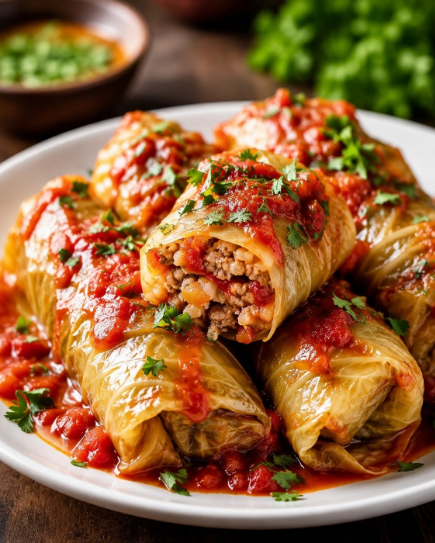
Tender cabbage leaves wrapped around a savory beef-and-rice filling, then slow-baked in a rich, homemade tomato sauce until meltingly tender.
Prep: 40 minutes
Cook: 1 hour 20 minutes
Total: About 2 hours
Yield: 6 servings / 12 large cabbage rolls
Difficulty: Moderate
Ingredients
For the cabbage rolls
1 large green cabbage, about 2½–3 lb (1.1–1.4 kg)
1 lb (450 g) ground beef, preferably 85/15
1 cup cooked long-grain white rice, cooled
1 medium yellow onion, finely diced
3 garlic cloves, minced
1 large egg
¼ cup fresh parsley, finely chopped
1 tsp sweet paprika
1 tsp kosher salt
½ tsp freshly ground black pepper
½ tsp dried oregano
¼ tsp red pepper flakes, optional
For the homemade tomato sauce
2 tbsp olive oil
1 small yellow onion, finely diced
3 garlic cloves, minced
2 tbsp tomato paste
1 can (28 oz/794 g) crushed tomatoes
1 can (15 oz/425 g) tomato sauce
½ cup beef or vegetable broth
1 tsp sugar, optional
1 tsp dried oregano
½ tsp paprika
1 bay leaf
½ tsp salt, or to taste
¼ tsp black pepper
1 tbsp fresh parsley, chopped
For serving
Fresh parsley
Sour cream, optional
Extra tomato sauce
Crusty bread, optional
Instructions
1. Prepare the cabbage
Bring a large pot of salted water to a boil.
Cut around the cabbage core with a sharp knife. Carefully place the whole cabbage into the boiling water, core-side down.
After about 2–3 minutes, the outer leaves should begin loosening. Remove them carefully with tongs and transfer them to a bowl of cold water. Continue until you have about 12 good-sized leaves. This blanching technique is also used in established stuffed-cabbage recipes.
Pat the leaves dry.
Using a small knife, carefully shave down the thick central rib at the bottom of each leaf. Don’t cut completely through the leaf—you simply want it flexible enough to roll.
Tip: Keep the smaller or torn leaves. They can be placed underneath the rolls to prevent sticking.
2. Make the tomato sauce
Heat the olive oil in a saucepan over medium heat.
Add the diced onion and cook for 4–5 minutes, until softened.
Add the garlic and cook for another 30–60 seconds.
Stir in the tomato paste and cook for about 1 minute.
Add:
crushed tomatoes
tomato sauce
broth
oregano
paprika
bay leaf
sugar, if using
salt
black pepper
Bring to a gentle simmer.
Cook uncovered for 15–20 minutes, stirring occasionally. Remove the bay leaf before using.
The sauce should be flavorful but still somewhat loose because it will continue cooking in the oven.
3. Prepare the filling
In a large bowl, combine:
ground beef
cooked cooled rice
diced onion
minced garlic
egg
parsley
paprika
salt
pepper
oregano
red pepper flakes
Mix gently with your hands or a fork just until everything is evenly combined.
Don’t knead the mixture excessively; overmixing can make the meat filling dense.
4. Fill the cabbage leaves
Place one cabbage leaf flat on your work surface.
Put approximately ⅓ cup of filling near the lower center of the leaf.
Fold the bottom edge over the filling.
Fold both sides toward the center.
Then roll upward firmly, like a small burrito.
Place the cabbage roll seam-side down.
Repeat with the remaining cabbage leaves and filling.
5. Assemble
Preheat your oven to 350°F (175°C).
Spread approximately 1 cup of tomato sauce over the bottom of a 9 × 13-inch baking dish.
Arrange the cabbage rolls tightly in the dish, seam-side down.
Pour the remaining sauce over the top, making sure the rolls are well covered.
Cover the dish tightly with aluminum foil.
6. Slow-bake
Bake at 350°F for 60 minutes.
Remove the foil and continue baking for another 15–20 minutes, until the sauce is bubbling and the cabbage is exceptionally tender.
The center of the meat filling should reach at least 160°F (71°C) when checked with an instant-read thermometer; using a thermometer is preferable to judging doneness by appearance.
For especially soft cabbage, you can keep the rolls covered for the entire first 75 minutes.
7. Rest and serve
Allow the cabbage rolls to rest for 5–10 minutes.
Spoon plenty of tomato sauce over each roll and sprinkle with fresh parsley.
For the presentation shown in your photo, cut one roll diagonally in half and place it on top of the others so the beef-and-rice filling is visible.
A spoonful of sour cream on the side is excellent.
Nutrition Information
Approximate per serving, assuming 2 cabbage rolls per serving and without sour cream or bread:
Nutrient Approx. amount
Calories 470 kcal
Protein 29 g
Carbohydrates 42 g
Fat 22 g
Saturated fat 7 g
Fiber 7 g
Sugars 10 g
Sodium 850 mg
Cholesterol 105 mg
Nutrition is an estimate and will vary with the fat percentage of the beef, exact tomato products, rice quantity, and amount of salt used.
Dietary Information
Nut-free: Yes
Soy-free: Yes, provided your tomato products and broth are soy-free
Egg-free: No — but the egg can be omitted
Dairy-free: Yes, if served without sour cream
Gluten-free: Naturally gluten-free if you use certified gluten-free broth and check packaged ingredients
Pork-free: Yes
Vegetarian: No
Easy Substitutions
Beef: Use ground beef and pork, turkey, chicken, or lamb. A beef/pork combination gives particularly rich results.
Rice: Brown rice, basmati, converted/parboiled rice, quinoa, or another cooked grain can work. Cooked grains are a common variation for cabbage-roll fillings.
Cabbage: Savoy cabbage works beautifully and produces very tender, flexible leaves.
Spicier: Add ½–1 tsp red pepper flakes or a pinch of cayenne.
Sweeter sauce: Increase the sugar to 2 tsp.
Tangier sauce: Add 1 tbsp lemon juice or apple cider vinegar at the end of cooking.
Creamy: Serve with sour cream or Greek yogurt.
Make-Ahead Instructions
You can assemble the cabbage rolls up to 24 hours ahead.
Prepare and roll them, place them in the baking dish with the sauce, cover tightly, and refrigerate.
When ready to bake, take the dish from the refrigerator while the oven preheats. Because the rolls are starting cold, they may need an additional 10–20 minutes of baking time.
Always check the center with a thermometer.
Freezing
Before baking
Assemble the rolls and sauce in a freezer-safe baking dish. Cool/refrigerate the assembled dish first, then freeze tightly covered.
Thaw overnight in the refrigerator before baking.
After baking
Cool completely, portion into airtight containers, and freeze with plenty of sauce.
They generally reheat best when covered so the cabbage doesn’t dry out.
Storage
Refrigerate leftovers within 2 hours.
Store covered in the refrigerator and use within about 3–4 days for best quality.
Reheat gently in a covered saucepan or covered baking dish with some extra tomato sauce.
Frequently Asked Questions
Q: Can I use uncooked rice?
Yes, but I recommend cooked rice for this version. It gives you more predictable results and prevents the filling from needing additional liquid and cooking time.
Q: Why are my cabbage leaves tearing?
They probably haven’t been softened enough. Return the cabbage head to the simmering water and remove additional leaves as they become flexible. Also trim the thick central rib without cutting through the leaf.
Q: Why is my filling dry?
Make sure there’s plenty of tomato sauce around the rolls and keep the dish tightly covered during most of the baking time. The enclosed sauce creates a moist cooking environment.
Q: Why is the filling tough?
Avoid overmixing the meat. Combine the ingredients only until incorporated.
Q: Can I use raw onion in the filling?
Yes. However, sautéing the onion first gives the rolls a sweeter, more developed flavor.
Q: Do I need to brown the beef first?
No. The ground beef cooks inside the cabbage rolls while they bake in the sauce. Browning is optional rather than necessary.
Q: Can I make these with pork?
Absolutely. Replace some or all of the beef with ground pork. A beef-and-pork combination is especially flavorful.
Q: Can I make them without eggs?
Yes. Simply omit the egg. The rice and meat will still hold together, although the filling may be slightly less cohesive.
Q: Can I make vegetarian cabbage rolls?
Yes. Replace the meat with a mixture of cooked lentils, mushrooms, beans, and/or additional grains. Stuffed cabbage recipes are quite adaptable to different grains and legumes.
Q: How do I know they’re done?
The cabbage should be very tender, the sauce should be bubbling, and the meat filling should reach at least 160°F (71°C) in the center.
Q: Can I make the sauce sweeter?
Definitely. Add 1–2 teaspoons sugar to balance acidic tomatoes. Taste the sauce before assembling and adjust the salt, sugar, and acidity to your preference.
Q: What should I serve with cabbage rolls?
They’re substantial enough to be a complete meal. Good sides include:
Cucumber-dill salad
Mashed potatoes
Roasted vegetables
Crusty bread
Simple green salad
Pickles or sauerkraut
Q: Can I make smaller cabbage rolls?
Yes. Use 2–3 tablespoons of filling per leaf and reduce the cooking time slightly. Keep the sauce plentiful and check the filling’s internal temperature.
Q: Why does the dish taste even better the next day?
The cabbage, meat, rice, and tomato sauce have time to absorb each other’s flavors. For that reason, cabbage rolls are an excellent make-ahead dinner.

With years of experience in restaurant research and local SEO, Sara creates accurate, user-friendly guides that work for both people and search engines. Her goal is to help users go from search results to their nearest restaurant or menu choice with as few clicks as possible.
- Grandma’s Cream Puffs – Light, Crisp & Creamy - October 17, 2026
- Easy Crockpot Creamy Garlic Parmesan Chicken - October 17, 2026
- Garlic Herb Roasted Potatoes - October 17, 2026