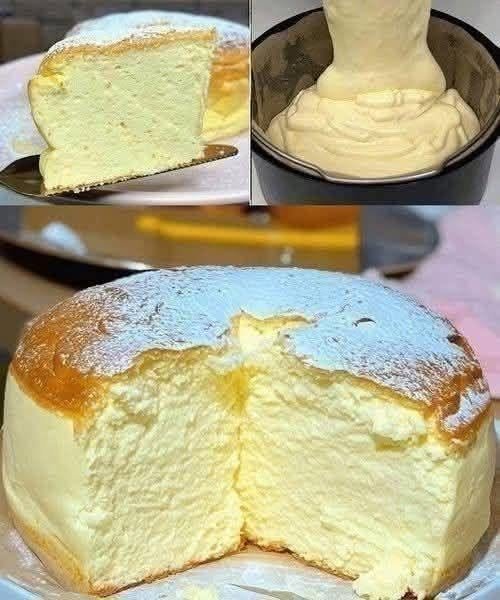
Yield: 1 round cake, about 8 inches / 20 cm
Servings: 8–10
Texture: Extremely soft, airy, moist and creamy
Difficulty: Intermediate
Prep: 25–35 minutes
Bake: about 60–80 minutes
Cooling/chilling: 3–6 hours
Ingredients
Cream-cheese batter
250 g full-fat cream cheese, room temperature
60 g unsalted butter
100 ml whole milk
6 large eggs, separated
80 g granulated/caster sugar, divided
60 g cake flour
20 g cornstarch/cornflour
1 tsp vanilla extract
1 tsp fresh lemon juice
1/4 tsp salt
For the pan
Butter or neutral oil for greasing
Parchment paper
Aluminum foil if using a loose-bottom/springform pan
Hot water for the water bath
This ingredient balance is consistent with established cotton-cheesecake formulas using cream cheese, butter, milk, separated eggs, cake flour/cornstarch and a meringue.
D
Delicious Recipe
+1
Step-by-Step Method
1. Prepare the pan
Use an 8-inch / 20-cm round cake pan.
Grease the bottom and sides lightly and line the bottom with parchment.
If your pan has a removable bottom, wrap the outside very securely with 2–3 layers of aluminum foil so water cannot enter during baking. A solid cake pan is even easier for a water bath.
R
RecipeTin Japan
Do not skip the parchment.
2. Separate the eggs
Separate the 6 eggs carefully.
Put:
yolks in one bowl
whites in a completely clean, dry bowl
Important: Not even a small amount of egg yolk or grease should get into the whites, otherwise the meringue may fail.
For best volume, use eggs that aren’t ice-cold.
3. Melt the cream cheese mixture
Place the cream cheese, butter and milk in a heatproof bowl.
Set the bowl over a saucepan containing gently simmering water.
Stir until everything becomes completely smooth.
Don’t boil the mixture.
Remove from the heat.
Let it cool for a few minutes.
4. Add the egg yolks
Add the egg yolks one at a time, whisking after each addition.
Add:
vanilla
lemon juice
salt
Mix until smooth.
5. Add the flour
Sift together:
60 g cake flour
20 g cornstarch
Add them to the cream-cheese mixture.
Whisk gently until there are no visible lumps.
For an especially smooth cheesecake, pass this mixture through a fine-mesh sieve.
Don’t vigorously beat it.
6. Make the meringue — the most important step
Place the egg whites in a perfectly clean bowl.
Beat at medium speed until foamy.
Gradually add the remaining sugar in 3–4 additions while beating.
Continue until the meringue is glossy and holds soft-to-medium peaks.
When you lift the whisk:
the peak should stand but gently bend at the tip
it should look smooth and glossy
it should not be dry or chunky
This is one of the most important parts of the recipe. Over-whipped whites can make folding difficult and contribute to cracking or collapse.
B
BAKE WITH PAWS
+1
7. Combine the meringue and cheese batter
Add approximately 1/3 of the meringue to the cream-cheese batter.
Fold gently to lighten the batter.
Add another 1/3.
Fold again.
Add the final 1/3 and gently fold until the mixture is mostly uniform.
Use a large spatula and make bottom-to-top folding motions.
Do not stir aggressively.
You want to preserve the tiny air bubbles that make the cake fluffy.
8. Fill the pan
Pour the batter into the prepared pan.
Gently tap the pan against the counter a couple of times to remove only the large bubbles.
Don’t bang it repeatedly—you don’t want to destroy the meringue.
If you see a large bubble near the surface, you can gently run a skewer through it.
9. Prepare the water bath
Place the cake pan inside a larger roasting/baking pan.
Pour hot water into the outer pan.
Aim for approximately 1.5–2.5 cm (½–1 inch) of water around the cake pan. Different established recipes use slightly different water depths, but the purpose is the same: gentle, humid and even baking.
B
BAKE WITH PAWS
+1
Be careful not to splash water into the cheesecake.
10. Bake
Recommended starting schedule
Preheat the oven to:
160°C / 320°F
Place the cheesecake in the water bath.
Bake:
160°C / 320°F — 20 minutes
Then reduce to:
140°C / 284°F — approximately 40–50 minutes
Then turn the oven OFF.
Leave the cake inside for about:
20–30 minutes
with the door slightly ajar.
This gradual cooling is important because sudden temperature changes can cause the soufflé structure to shrink dramatically.
R
RecipeTin Japan
+1
Important oven note
Every oven behaves differently. Some successful recipes use a lower-temperature, longer bake, while others use a higher initial temperature followed by a reduction.
B
BAKE WITH PAWS
+1
If your oven runs hot, reduce the temperatures by roughly 10°C.
An inexpensive oven thermometer is extremely useful for this cake.
11. How do you know it’s done?
The cake should:
have a golden/light-brown top
be noticeably risen
feel set around the edges
have a gentle jiggle in the center
not look like liquid batter
A slight wobble is normal.
If the center is still visibly wet, continue baking.
One established method recommends checking the center with a thin skewer; it should come out dry rather than coated with wet batter.
R
RecipeTin Japan
12. Cool it correctly
After the oven is turned off, leave the cake inside for 20–30 minutes.
Then remove it from the water bath.
Let it cool further.
Once cool enough to handle, carefully remove it from the pan.
Refrigerate for at least 4 hours; overnight gives an even more settled, creamy texture.
J
Just One Cookbook
Dust with powdered sugar before serving.
For the exact fluffy look in your photo
For that very tall, cloud-like appearance:
Use full-fat cream cheese.
Use cake flour rather than strong/high-protein flour.
Keep the egg whites completely free of yolk.
Don’t overbeat the meringue.
Fold gently.
Don’t skip the water bath.
Don’t open the oven repeatedly.
Don’t take the cake immediately from a hot oven into a cold room.
Let it cool gradually.
Don’t overbake it.
The water bath and gradual cooling are particularly important for preventing cracking and severe collapse.
G
Gimme Yummy Recipes
+1
Allergy & Nutrition Information
Common allergens
This recipe contains:
Milk/dairy: cream cheese, butter, milk
Eggs
Wheat/gluten: cake flour
Nuts
No nuts are required.
It is naturally:
peanut-free by ingredients
tree-nut-free by ingredients
However, if you’re preparing it for someone with a serious allergy, check the labels of the cream cheese, chocolate/flavorings and other packaged ingredients for may-contain statements and avoid cross-contamination.
Approximate nutrition
For the whole cake, the recipe is approximately:
Calories: 2,500–2,800 kcal
Protein: ~55–65 g
Carbohydrates: ~200–220 g
Fat: ~165–180 g
Sugar: ~100–115 g
Per 10 slices, approximately:
250–280 kcal
5–7 g protein
20–22 g carbohydrates
16–18 g fat
These are estimates rather than laboratory nutrition values and will change according to the brands of cream cheese, butter, milk and sugar used.
Japanese Cotton Cheesecake Q&A
Why did my cheesecake collapse?
A small amount of sinking is normal.
A dramatic collapse usually means one or more of these happened:
center was underbaked
meringue was improperly whipped
meringue was overmixed during folding
oven temperature was too high
cake cooled too rapidly
water bath was inadequate
R
Recipe Doctor
+1
Why did it crack?
Usually the surface became too hot/dry and set before the inside finished expanding.
Possible causes include:
oven too hot
convection/fan oven
insufficient water bath
meringue too stiff
sudden temperature changes
G
GetCookMatch
+1
Why is the cake dense?
Most often, too much air was lost from the meringue.
Common mistakes:
Overbeating → difficult, heavy meringue
Aggressive folding → deflated batter
Strong flour → potentially heavier texture
Skipping water bath → less gentle baking
Cake flour is preferable because it helps maintain a delicate crumb.
R
recipeneverseen
+1
Why is there a wet layer at the bottom?
The cake may have:
been underbaked
had water enter the pan
been baked in an insufficiently hot water bath
If using a springform pan, wrap it very carefully or use a solid-bottom pan.
G
Gimme Yummy Recipes
Can I use all-purpose flour?
Yes, but cake flour gives a more delicate result.
If you don’t have cake flour, a common substitute is to replace part of the all-purpose flour with cornstarch and sift thoroughly.
J
Just One Cookbook
Can I use a springform pan?
Yes, but it must be very well protected from the water bath.
A solid-bottom pan is safer.
Can I make it without a water bath?
Technically yes, but I don’t recommend it for this particular texture. The water bath provides a gentler, humid baking environment and helps reduce cracking.
B
BAKE WITH PAWS
+1
Why did the cake rise beautifully and then shrink?
That’s classic soufflé behavior.
Some shrinkage is expected. If it falls dramatically, the internal structure wasn’t strong enough to hold the expanded air/steam as the cake cooled. Gradual cooling helps enormously.
R
Recipe Doctor
+1
Can I eat it warm?
Yes. It will be extremely soft and bouncy.
For a creamier, cleaner slice, refrigerate it for several hours.
How long does it keep?
Keep covered in the refrigerator for about 3–4 days.
J
Just One Cookbook
Can I freeze it?
Yes. Wrap it very well and freeze for approximately 3–4 weeks. Thaw overnight in the refrigerator.
J
Just One Cookbook
Can I add lemon?
Absolutely. The 1 teaspoon of lemon juice in this recipe gives subtle acidity. You can also add a little finely grated lemon zest for a stronger citrus flavor.
Can I add vanilla?
Yes—the 1 teaspoon specified above gives a pleasant vanilla background without overpowering the cheesecake.
The 5 rules that matter most
If you remember nothing else, remember these:
1. Clean egg whites.
2. Glossy soft/medium-peak meringue.
3. Gentle folding.
4. Water bath.
5. Slow cooling.

With years of experience in restaurant research and local SEO, Sara creates accurate, user-friendly guides that work for both people and search engines. Her goal is to help users go from search results to their nearest restaurant or menu choice with as few clicks as possible.
- Stuffed Cabbage Rolls - October 18, 2026
- Easy Crockpot Creamy Garlic Parmesan Chicken - October 18, 2026
- Turmeric Carrot Lentil Stew - October 18, 2026