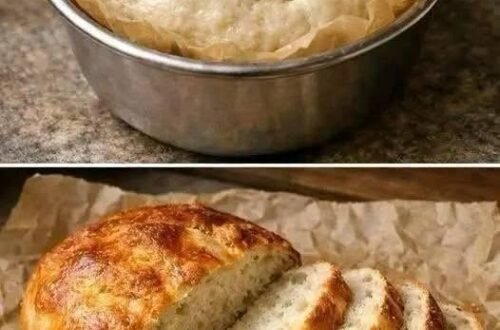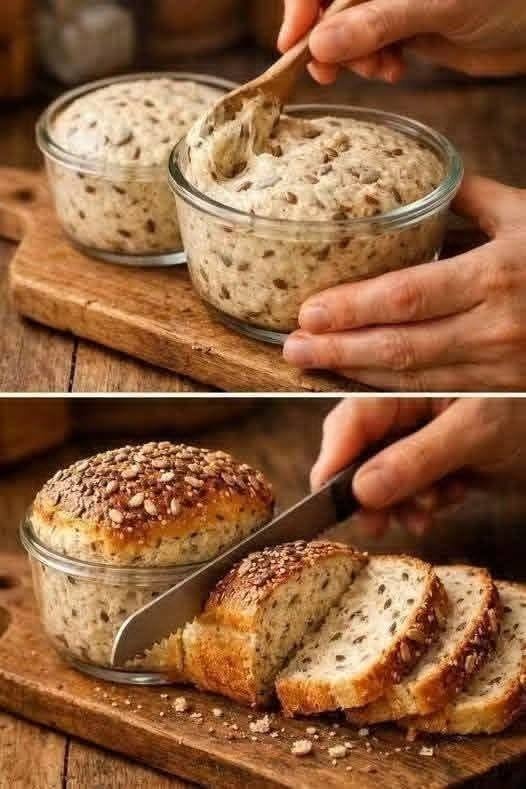
The photo appears to show a rustic, high-hydration seeded bread: the dough is mixed and left to rise in containers, then baked into a golden loaf covered with seeds and sliced into a moist, hearty crumb. A long overnight rise and a Dutch oven are both well-suited to this style.
P
PBS
+1
This version includes nuts + seeds for the crunchy, nutty appearance in the photo.
Recipe at a glance
Yield: 1 large loaf, about 10–12 slices
Hands-on time: 15–20 minutes
First rise: 12–18 hours
Second rise: 1–1½ hours
Bake: about 55–60 minutes
Difficulty: Easy
Equipment: 5–6 quart Dutch oven, large bowl, kitchen scale if available
Ingredients
For the dough
Ingredient Amount
Bread flour 350 g / about 2¾ cups
Whole-wheat flour 150 g / about 1¼ cups
Rolled oats 40 g / ½ cup
Warm or room-temperature water 425–450 g / 1¾–1⅞ cups
Instant yeast 1½ tsp / about 5 g
Fine salt 10 g / about 1¾ tsp
Honey 1 tbsp / 20 g
Olive oil 1 tbsp
Seeds
Pumpkin seeds/pepitas — 40 g
Sunflower seeds — 30 g
Flaxseed — 20 g
Sesame seeds — 20 g
Chia seeds — 10 g
Nuts
Chopped walnuts — 40 g
Chopped almonds — 30 g
Optional: chopped hazelnuts — 20 g
Total nuts: about 90 g
Total seeds: about 120 g
You can reduce the nuts to 50–60 g if you prefer a softer loaf.
For the topping
2 tbsp pumpkin seeds
1 tbsp sunflower seeds
1 tbsp sesame seeds
1 tbsp chopped nuts
1 tbsp rolled oats
A little water or milk for helping the topping stick
Detailed Method
1. Prepare the nuts and seeds
If you want a particularly flavorful loaf, lightly toast the walnuts, almonds and pumpkin/sunflower seeds.
Heat a dry skillet over medium-low heat.
Add the nuts and larger seeds and toast for approximately 3–5 minutes, stirring frequently.
Do not let them become dark brown.
Allow them to cool completely before mixing them into the dough.
Tip: Don’t toast flax or chia seeds for this recipe. They are small and can burn easily.
2. Soak the flax and chia
Combine:
20 g flaxseed
10 g chia seeds
80 g of the water
Mix and leave for 20–30 minutes.
They will absorb water and form a slightly gel-like mixture.
This is useful because flax and chia absorb considerable amounts of water. Seeded no-knead recipes commonly use a separate soaking step for water-hungry seeds.
B
Budget Bytes
3. Mix the dry ingredients
In a large bowl combine:
350 g bread flour
150 g whole-wheat flour
40 g oats
5 g instant yeast
10 g salt
40 g pumpkin seeds
30 g sunflower seeds
20 g sesame seeds
cooled chopped nuts
Mix thoroughly.
4. Add the liquids
Mix together:
345–370 g remaining water
20 g honey
1 tbsp olive oil
soaked flax/chia mixture
Pour into the flour mixture.
Using a wooden spoon or your hand, mix until no dry flour remains.
The dough should be:
very sticky
soft
loose
slightly shaggy
Don’t add lots of extra flour.
A relatively wet dough is intentional. Seeds also absorb water, so the dough can become noticeably firmer as it rests.
B
Budget Bytes
+1
5. Overnight fermentation
Cover the bowl tightly.
Leave at room temperature for approximately 12–18 hours.
The dough should become:
visibly expanded
bubbly
airy
roughly doubled in volume
A long 12–18-hour rise is characteristic of this type of no-knead bread.
P
PBS
+1
If your kitchen is warm
If your room is around 75–80°F / 24–27°C, start checking the dough after about 10–12 hours.
If your kitchen is cool, it may need the full 16–18 hours.
6. Shape the loaf
Generously flour your work surface.
Scrape the dough onto it.
Fold the dough over itself several times, then gently form it into a round boule.
Don’t aggressively knead it.
Place the shaped dough on parchment paper or into a well-floured proofing basket/bowl.
7. Add the beautiful seed topping
Lightly brush or spray the surface with water.
Mix the topping:
pumpkin seeds
sunflower seeds
sesame seeds
chopped nuts
oats
Press the mixture gently onto the surface.
Don’t press so hard that you deflate the dough.
The seed-heavy crust is consistent with classic seeded overnight bread recipes, which use pumpkin, flax, poppy and sesame seeds both inside and on top.
P
PBS
+1
8. Second rise
Cover loosely.
Allow the loaf to rise for approximately 60–90 minutes.
It doesn’t necessarily need to double.
A gentle finger press should leave an indentation that slowly springs back.
9. Preheat the Dutch oven
Place your Dutch oven with its lid inside the oven.
Preheat to:
475°F / 245°C
Allow the Dutch oven to heat for at least 30 minutes.
The preheated pot and trapped steam help produce the characteristic crust of no-knead bread.
S
simmerandsauce.com
+1
10. Score the bread
Carefully transfer the dough into the hot Dutch oven using the parchment.
Make one deep slash across the top, or make an X.
This gives the expanding loaf a controlled place to open.
11. Bake
Put the lid on.
Immediately reduce the oven temperature to:
450°F / 230°C
Bake covered for:
40–45 minutes
Then remove the lid.
Bake another:
10–15 minutes
until the crust is deep golden brown.
The covered-then-uncovered baking approach is also used in established seeded overnight bread recipes.
P
PBS
+1
12. Cool completely
Remove the bread from the Dutch oven.
Place it on a wire rack.
Wait at least 1 hour before slicing.
For the best crumb, 90 minutes is even better.
Don’t cut it immediately after baking. The interior continues setting as it cools.
How to get slices like the picture
Use a sharp serrated bread knife.
Cut with a gentle back-and-forth motion rather than pushing straight down.
Aim for slices approximately ½–¾ inch thick.
The bread should have:
crunchy seeded crust
moist interior
visible nuts and seeds
slightly chewy texture
nutty whole-grain flavor
Complete Nut Information
Walnuts
Flavor: rich, buttery, slightly bitter
Best amount: 30–50 g
Texture: soft-crunchy
Best pairing: whole wheat + flax + honey
Almonds
Flavor: mild and sweet
Best amount: 20–40 g
Texture: firm crunch
Best pairing: sunflower and sesame seeds
Hazelnuts
Flavor: intensely nutty
Best amount: 15–30 g
Texture: crunchy
Best pairing: whole wheat + sesame
Pecans
You can substitute pecans for walnuts.
They give the bread a sweeter, buttery flavor.
Important nut allergy note
If serving this to someone with a tree-nut allergy, omit walnuts, almonds, hazelnuts and pecans and use additional seeds instead.
Also check your flour, oats, seeds and other packaged ingredients for allergen/cross-contact statements if the allergy is severe.
Seed Substitution Guide
You don’t need to use exactly the same seeds.
Replace pumpkin seeds with:
sunflower seeds
chopped almonds
sesame
Replace sunflower seeds with:
pumpkin seeds
hemp hearts
chopped walnuts
Replace flax with:
extra chia
hemp hearts
sesame
Replace chia with:
ground flax
Be aware that chia and flax affect hydration, so don’t substitute huge quantities without adjusting the water.
Why this bread works
The combination of bread flour + whole wheat flour gives you a good balance between structure and whole-grain flavor. Using a very high proportion of whole-wheat flour can make a no-knead loaf denser, so combining it with bread or white flour is a practical approach.
B
Budget Bytes
+1
The long fermentation develops flavor without requiring traditional kneading.
The Dutch oven provides a humid environment early in baking, helping the loaf expand before the crust hardens.
Recipe Q&A
Q: Can I make it without nuts?
Yes. Replace the 90 g nuts with approximately 90 g additional seeds.
A combination of pumpkin + sunflower + sesame works particularly well.
Q: Can I use only whole-wheat flour?
Yes, but expect a denser, heavier loaf. Whole-wheat flour behaves differently from bread flour, and high whole-wheat percentages can reduce the airy texture of no-knead bread.
B
Budget Bytes
For a lighter loaf, keep at least 40–50% of the flour as bread or strong white flour.
Q: Can I use active dry yeast?
Yes.
Use approximately 1¾ tsp active dry yeast and dissolve it in some of the water before mixing.
Q: Can I use sourdough starter instead?
Yes, but this becomes a different fermentation system.
For a sourdough version, I’d recommend using an active starter and adjusting the flour/water rather than simply adding starter to this recipe.
Q: Why is my dough extremely sticky?
That’s normal initially.
Seeds, oats and whole-wheat flour absorb water over time.
Let the dough rest before deciding that it needs more flour.
When shaping, use floured or lightly wet hands rather than adding lots of flour.
Q: Why did my bread come out dense?
Common causes include:
Yeast was old or inactive.
Dough didn’t ferment long enough.
Kitchen temperature was too cold.
Too much flour was added during shaping.
The dough was heavily deflated.
The loaf was cut while still hot.
Q: Why didn’t my bread rise?
Check the yeast first.
Also remember that fermentation time depends strongly on room temperature.
A cold kitchen can require considerably more time.
Q: Why did my seeds fall off?
The topping needs something to adhere to the dough.
Lightly wet the surface before adding the seeds and gently press them into the dough.
Q: Can I bake this in a loaf pan?
Yes.
A loaf pan will produce a more sandwich-like shape, but the crust won’t be quite like the Dutch-oven version.
Covering the loaf during the initial baking stage can help retain steam.
Q: Can I make two smaller loaves?
Yes.
Divide the finished dough into two equal portions.
Reduce the baking time and begin checking the loaves earlier.
Q: Can I refrigerate the dough?
Yes.
After the initial fermentation, you can refrigerate the dough to slow fermentation.
Bring it out, shape it and allow it to warm/proof before baking.
Q: How should I store the bread?
Once completely cool, store it in a bread bag or wrapped at room temperature.
For best quality, eat it within 2–3 days. A comparable seeded overnight bread recipe recommends tightly wrapping and keeping the loaf at room temperature for up to three days.
M
Martha Stewart
For longer storage, slice and freeze it.
Freezing
Slice the completely cooled loaf.
Put parchment between slices if you want to remove individual pieces.
Place in a freezer-safe bag and freeze for up to about 2–3 months for best quality.
Toast directly from frozen.
Best ways to eat it
This bread is excellent with:
butter + honey
cream cheese
avocado
hummus
peanut or almond butter
cheese
eggs
smoked salmon
roasted vegetables
soup
chicken or turkey sandwiches
For a particularly good breakfast, toast it and add butter + honey + chopped walnuts.
Approximate nutrition
Nutrition varies substantially with the exact flour, nuts and seeds, so these are rough estimates, not laboratory values.
For approximately 10 slices:
Nutrient Approx. per slice
Calories 220–250 kcal
Protein 7–9 g
Carbohydrates 32–36 g
Fat 7–9 g
Fiber 5–7 g
Sugar 2–3 g
The nuts and seeds substantially increase the bread’s protein, unsaturated fat, fiber and mineral content compared with plain white bread.
My recommended version
For the closest balance of soft interior + crunchy crust + strong nutty flavor, I’d use:
350 g bread flour + 150 g whole wheat + 40 g walnuts + 30 g almonds + 40 g pumpkin seeds + 30 g sunflower seeds + 20 g flax + 20 g sesame + 10 g chia.

With years of experience in restaurant research and local SEO, Sara creates accurate, user-friendly guides that work for both people and search engines. Her goal is to help users go from search results to their nearest restaurant or menu choice with as few clicks as possible.
- Grandma’s Cream Puffs – Light, Crisp & Creamy - October 17, 2026
- Easy Crockpot Creamy Garlic Parmesan Chicken - October 17, 2026
- Garlic Herb Roasted Potatoes - October 17, 2026