Yield: 1 large boule
Prep: 30–45 minutes active time
Bulk fermentation: about 5–8 hours
Cold proof: 8–18 hours
Bake: about 40–45 minutes
Difficulty: Intermediate
Ingredients
Sourdough dough
500 g bread flour
350 g water, room temperature
100 g active sourdough starter, at or near peak
10 g fine sea salt
25–30 g granulated sugar — optional, but recommended for the blueberry version
Zest of 1 large lemon
150–200 g fresh blueberries
1 tsp vanilla extract — optional
The 500 g flour/100 g starter/350 g water ratio gives a manageable dough while leaving enough flexibility for the moisture released by the berries. Comparable blueberry sourdough formulas use around 150 g blueberries, while higher-hydration versions can use considerably more.
N
Natasha’s Baking
+1
Optional topping
1–2 tsp coarse sugar
A little flour or rice flour for dusting
Extra blueberries for decoration, if desired
Step 1 — Prepare the starter
Your starter should be active, bubbly and risen significantly, preferably at or near its peak.
If your starter has been refrigerated, feed it several hours before making the dough.
A simple feeding:
20 g mature starter
40 g water
40 g bread flour
Mix and leave somewhere warm until doubled or more and visibly bubbly.
Don’t use a starter that has just been fed and is still flat. Fermentation will be much slower.
Step 2 — Prepare the lemon sugar
Put:
25–30 g sugar
zest of 1 lemon
into a small bowl.
Rub the zest into the sugar with your fingertips for 30–60 seconds.
This releases the lemon oils and gives you much stronger lemon flavor than simply throwing the zest into the dough.
Set aside.
🫐 Step 3 — Prepare the blueberries
Wash the blueberries and dry them extremely well.
This is important.
Wet berries add additional water to an already-hydrated dough and can make shaping difficult.
If your blueberries are very large, you can leave them whole. Don’t crush them beforehand.
Fresh blueberries are preferable for the appearance in your photo. Frozen berries tend to release more juice and can create much heavier purple bleeding through the dough.
N
Natasha’s Baking
+1
Step 4 — Mix the dough
In a large bowl combine:
350 g water
100 g active starter
Mix until the starter is mostly dispersed.
Add:
500 g bread flour
Mix until you have no dry flour remaining.
Don’t worry if the dough looks rough.
Cover and rest for 30–60 minutes.
This resting period allows the flour to hydrate and the gluten to begin developing.
Step 5 — Add salt and lemon sugar
Add:
10 g salt
lemon zest/sugar mixture
vanilla, if using
Wet your hands and squeeze/fold the dough repeatedly until everything is incorporated.
The dough will initially feel sticky.
That’s normal.
Step 6 — Stretch and folds
Over the next 2 hours, perform approximately 4 sets of stretch-and-folds.
First fold
30 minutes after adding the salt.
Second fold
30 minutes later.
Third fold
30 minutes later.
Fourth fold
30 minutes later.
For each set:
Grab one side of the dough.
Stretch it upward gently.
Fold it over the center.
Rotate the bowl.
Repeat 3–4 times.
By the end, the dough should feel noticeably stronger and more elastic.
🫐 Step 7 — Add the blueberries
This is the most important part for getting the appearance in your photograph.
After the dough has developed some strength, gently turn it onto a very lightly dampened or lightly floured work surface.
Stretch it carefully into a rough rectangle.
Don’t aggressively flatten it.
Scatter approximately half the blueberries across the dough.
Fold the dough into thirds.
Add the remaining blueberries.
Fold again.
Then gently roll or fold the dough into a loose package.
Important:
Don’t knead the blueberries into the dough.
Kneading will burst the berries and turn the entire dough purple.
You want some berries to remain intact while others naturally burst during fermentation and baking.
Blueberry sourdough recipes commonly incorporate the berries during later folds/lamination rather than at the initial mix.
N
Natasha’s Baking
+1
Step 8 — Bulk fermentation
Place the dough back into a lightly greased or clean bowl.
Cover.
Let ferment at approximately 74–78°F / 23–26°C.
Depending on the strength of your starter and room temperature, this may take approximately:
5–8 hours.
Don’t rely exclusively on the clock.
Look for:
Dough increased roughly 50–75%
Bubbles along the sides
Slightly domed surface
Dough looks airy
Dough jiggles when the bowl is gently shaken
Dough feels lighter and more elastic
You do not necessarily want to wait for a full doubling with this dough.
Over-fermentation can make a fruit-filled loaf difficult to shape.
Step 9 — Pre-shape
Turn the dough onto a lightly floured surface.
Gently form it into a round.
Try to keep the blueberries inside rather than pushing them through the surface.
Let it rest uncovered for approximately 20 minutes.
Step 10 — Final shaping
Lightly flour your banneton/proofing basket.
Turn the dough over.
Gently stretch it into a loose rectangle.
Fold:
Bottom third upward
Left side toward the center
Right side toward the center
Top portion downward
Then roll/fold into a boule.
Pinch the seam gently closed.
Place it seam-side up in your banneton.
Step 11 — Cold fermentation
Cover the basket.
Place it in the refrigerator for:
8–18 hours.
You can go longer, but blueberry sourdough is already a fairly delicate dough.
Cold fermentation develops flavor while making the dough considerably easier to score and transfer.
Step 12 — Preheat the oven
Put your Dutch oven inside the oven.
Preheat to:
475°F / 245°C
for at least 30–45 minutes.
A thoroughly preheated Dutch oven gives the loaf the strong initial oven spring needed for that round, rustic appearance.
Step 13 — Score
Take the dough directly from the refrigerator.
Turn it onto parchment paper.
Dust lightly with flour if desired.
Make one confident slash across the top using a bread lame or very sharp knife.
Don’t make too many cuts—the blueberries weaken the dough structure.
Step 14 — Bake
Carefully transfer the dough into the hot Dutch oven.
Covered
Bake at:
450°F / 232°C for 25–30 minutes
with the lid on.
Uncovered
Remove the lid.
Reduce to:
425–440°F / 218–227°C
and bake another:
12–18 minutes
until the crust is deeply golden brown.
A blueberry loaf can brown quickly because of the sugar and fruit, so watch the crust during the final stage.
One tested blueberry sourdough method uses a high-temperature covered bake followed by a lower-temperature uncovered bake and checks the center temperature before removing the loaf.
G
Grains In Small Places
How do I know it’s done?
For this particular bread, aim for approximately:
200–210°F / 93–99°C internal temperature.
The center should no longer feel gummy.
If the top is getting too dark before the center is done, loosely cover it with foil and continue baking.
Step 15 — COOL COMPLETELY
This is very important.
Don’t cut it immediately.
Let the loaf cool for at least:
2 hours
preferably longer.
The blueberry pockets contain a lot of moisture. Cutting too early can make the crumb look gummy even when the bread was properly baked.
One blueberry sourdough source specifically recommends cooling completely before slicing, and some bakers prefer letting the loaf rest overnight.
G
Grains In Small Places
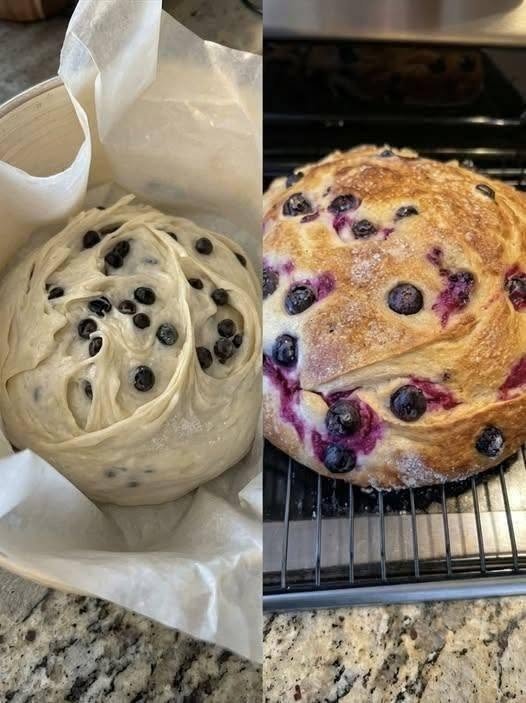
What you should get
The finished loaf should have:
Crisp golden-brown crust
Slightly sweet blueberry flavor
Tangy sourdough flavor
Lemon aroma
Purple/blue streaks around some berries
Juicy blueberry pockets
Soft, chewy crumb
Some larger irregular holes
Beautiful whole blueberries throughout
Serving ideas
This bread is fantastic with:
Simple
Salted butter + warm slice
Sweet
Butter + honey
Breakfast
Cream cheese + extra blueberries
Lemon-blueberry
Cream cheese + lemon zest + tiny drizzle of honey
Dessert
Mascarpone + blueberries + powdered sugar
My favorite
Salted butter + blueberry jam + fresh lemon zest
Approximate nutrition
Nutrition depends heavily on the amount of blueberries, sugar, starter composition and final loaf weight, so these are estimates rather than laboratory values.
For the entire loaf using 500 g flour, 100 g starter, 350 g water, 10 g salt, 30 g sugar and 175 g blueberries:
Approximate whole loaf:
Calories: 2,300–2,500 kcal
Carbohydrates: 450–480 g
Protein: 65–75 g
Fat: 8–12 g
Fiber: 25–30 g
Sugars: 35–50 g
Sodium: approximately 3,800–4,000 mg
Per 1/10 loaf
Approximately:
230–250 calories
45–48 g carbohydrates
6–8 g protein
1 g fat
3 g fiber
4–5 g sugars
Butter, cream cheese, honey or jam will obviously increase these numbers.
Allergy / dietary information
Contains
Wheat/gluten
Naturally free of
Eggs
Dairy
Nuts
Peanuts
Soy, assuming your flour/starter ingredients are free from cross-contact
Vegan?
Yes, if your sugar is vegan-certified and you don’t serve it with dairy.
Gluten-free?
No.
Sourdough fermentation does not make ordinary wheat bread gluten-free.
Nut-free?
The basic recipe contains no tree nuts or peanuts, but check your flour and other ingredients for manufacturing cross-contact if this is for someone with a serious allergy.
Q&A / Troubleshooting
Why did my dough turn completely purple?
You probably crushed too many blueberries while incorporating them.
For the marbled appearance in your picture, add the berries during lamination/folding and handle them gently.
Can I use frozen blueberries?
Yes.
But don’t completely thaw them and then add them dripping wet.
Frozen berries tend to bleed more color and release more liquid than fresh berries.
G
Grains In Small Places
For the closest appearance to the photo, I’d use fresh blueberries.
Can I use more blueberries?
Yes, but there’s a limit.
I’d recommend:
150–200 g: easiest to work with
200–250 g: very blueberry-heavy
300 g+: considerably more difficult to shape
More fruit means more moisture and weaker dough.
Can I leave out the sugar?
Absolutely.
The bread will be more traditional and less sweet.
I’d use 0–10 g for a classic sourdough flavor.
For the sweeter blueberry-bakery style shown in the photo, use 25–30 g.
Can I leave out the lemon?
Yes.
But lemon zest makes a huge difference to the blueberry flavor.
You don’t need lemon juice—the zest is enough.
USDA’s seasonal produce guidance also notes that lemon juice can enhance blueberry color in baked goods, although I prefer zest here because adding extra liquid to this dough isn’t necessary.
S
SNAP-Ed
Why is my bread gummy?
The most common causes are:
It was underbaked.
Too many blueberries were used.
The dough was over-fermented.
You sliced it while hot.
The berries released excessive moisture.
First, let the loaf cool completely.
Then check the internal temperature on your next bake.
Why did my loaf spread instead of rising?
Likely causes:
Over-proofing
Weak starter
Too much water
Too many blueberries
Insufficient gluten development
Dough became too warm
Try reducing the water by 15–25 g next time and make sure your starter is very active.
Why did blueberries fall out during shaping?
That’s normal to some degree.
Don’t try to force every berry completely inside.
If a berry is sitting directly on the surface, gently tuck it underneath and pinch the dough closed.
Can I use all-purpose flour?
Yes.
However, bread flour is preferable because it provides more gluten strength for holding the additional moisture from the blueberries.
If using all-purpose flour, start with about 325–335 g water rather than 350 g, then add more only if the dough needs it.
Can I add cinnamon?
Yes, but I’d use very little:
½–1 tsp cinnamon
Blueberry + lemon is the star here. Too much cinnamon can overpower the fruit.
Can I add white chocolate?
Yes—this is excellent.
Use:
75–100 g white chocolate chips/chunks + 150 g blueberries.
Add the chocolate at the same time as the blueberries.
Can I add cream cheese?
I’d not put ordinary cream cheese directly inside the sourdough dough for a long room-temperature fermentation.
Instead, bake the bread plain and serve it with cream cheese.
That gives you the blueberry-cheesecake flavor without complicating fermentation and storage.
How should I store it?
Once completely cool, keep it in a bread bag or loosely wrapped at room temperature.
For best texture, eat within about 2–3 days.
If you won’t finish it, slice it and freeze the slices.
For food safety, USDA recommends refrigerating perishable foods promptly and not leaving perishable foods at room temperature for extended periods.
U
USDA Food Safety and Inspection Service My exact version for the loaf in your photo
If your goal is as close as possible to the pictured loaf, I’d use:
500 g bread flour
350 g water
100 g active starter
10 g salt
30 g sugar
Zest of 1 lemon
175 g fresh blueberries
1 tsp vanilla
Then:
30–60 min autolyse → salt/sugar → 4 stretch-and-folds → laminate blueberries → bulk ferment → shape → overnight refrigerator → 450°F covered → 425–440°F uncovered → cool completely.

With years of experience in restaurant research and local SEO, Sara creates accurate, user-friendly guides that work for both people and search engines. Her goal is to help users go from search results to their nearest restaurant or menu choice with as few clicks as possible.
- Stuffed Cabbage Rolls - October 18, 2026
- Easy Crockpot Creamy Garlic Parmesan Chicken - October 18, 2026
- Turmeric Carrot Lentil Stew - October 18, 2026