Moist • Soft • Low-Carb • Gluten-Free • Sugar-Free
Yield
10–12 slices
Pan
9 × 5-inch loaf pan
Oven
350°F / 175°C
Prep
15 minutes
Bake
45–55 minutes
Ingredients
Cake
1 cup (240 g) unsweetened full-fat Greek yogurt
½ cup (50–55 g) finely ground almond flour
¼ cup (28–30 g) coconut flour
⅓ cup (65–70 g) granulated erythritol or monk-fruit/erythritol sweetener
⅓ cup (75 g) unsalted butter, melted and slightly cooled
3 large eggs, preferably room temperature
2 lemons
finely grated zest from both
2 tablespoons fresh lemon juice
1½ teaspoons vanilla extract
2 teaspoons baking powder
¼ teaspoon salt
Optional lemon glaze
½ cup powdered erythritol
1 tablespoon fresh lemon juice
1–2 tablespoons hot water, as needed
Optional topping
Extra lemon zest
Very thin lemon slices
A light dusting of powdered erythritol
Similar published versions use Greek yogurt, almond flour, coconut flour, eggs, butter, lemon, vanilla, erythritol and baking powder, with a simple powdered-sweetener lemon glaze.
Step-by-Step Instructions
1. Prepare the pan
Preheat the oven to 350°F (175°C).
Grease a 9 × 5-inch loaf pan and line it with parchment paper, leaving some parchment hanging over the long sides. This makes the finished cake much easier to remove.
2. Prepare the lemon
Wash and dry the lemons.
Finely grate the yellow outer peel to obtain the zest.
Important: Don’t grate deeply into the white part of the peel because the white pith can make the cake bitter.
Juice the lemons and measure 2 tablespoons.
For a particularly lemony cake, you can use up to 3 tablespoons of juice, but don’t add a large amount of extra liquid because the coconut flour absorbs moisture.
3. Mix the dry ingredients
In a medium bowl combine:
Almond flour
Coconut flour
Baking powder
Salt
Granulated sweetener
Whisk thoroughly so the coconut flour doesn’t remain in little clumps.
4. Mix the wet ingredients
In a large bowl whisk together:
Greek yogurt
Melted butter
Eggs
Lemon juice
Lemon zest
Vanilla
Mix until smooth.
The butter should be warm rather than hot. Very hot butter can partially cook the eggs.
5. Combine
Gradually add the dry ingredients to the wet ingredients.
Fold with a spatula until just combined.
Don’t aggressively overmix.
The batter will be thicker than ordinary wheat-flour cake batter. That’s normal because coconut flour absorbs a lot of liquid.
6. Fill the pan
Transfer the batter to the prepared loaf pan.
Spread the top evenly with a spatula.
Tap the pan gently against the counter once or twice to remove large air pockets.
7. Bake
Bake at 350°F / 175°C for approximately 45–55 minutes.
Start checking around 45 minutes.
The cake is done when:
The top is golden brown.
The center feels set.
A toothpick inserted into the center comes out clean or with a few moist crumbs.
The cake has begun pulling slightly away from the sides.
Published keto yogurt-cake versions use approximately 45–55 minutes at 350°F/175°C for a loaf pan.
If the top browns too quickly
Loosely cover the cake with aluminum foil for the final 10–15 minutes.
8. Cool Properly
This is particularly important with almond-flour cakes.
Leave the cake in the pan for about 15 minutes.
Then lift it out using the parchment and transfer it to a wire rack.
Allow it to cool completely before slicing.
If you cut it while it’s hot, the center can appear wet or crumbly even when the cake is properly baked.
Optional Lemon Glaze
Combine:
½ cup powdered erythritol
1 tablespoon lemon juice
Whisk.
Add hot water ½ teaspoon at a time until you reach a thick but pourable consistency.
Drizzle over the completely cooled cake.
Let the glaze set for approximately 10 minutes before slicing.
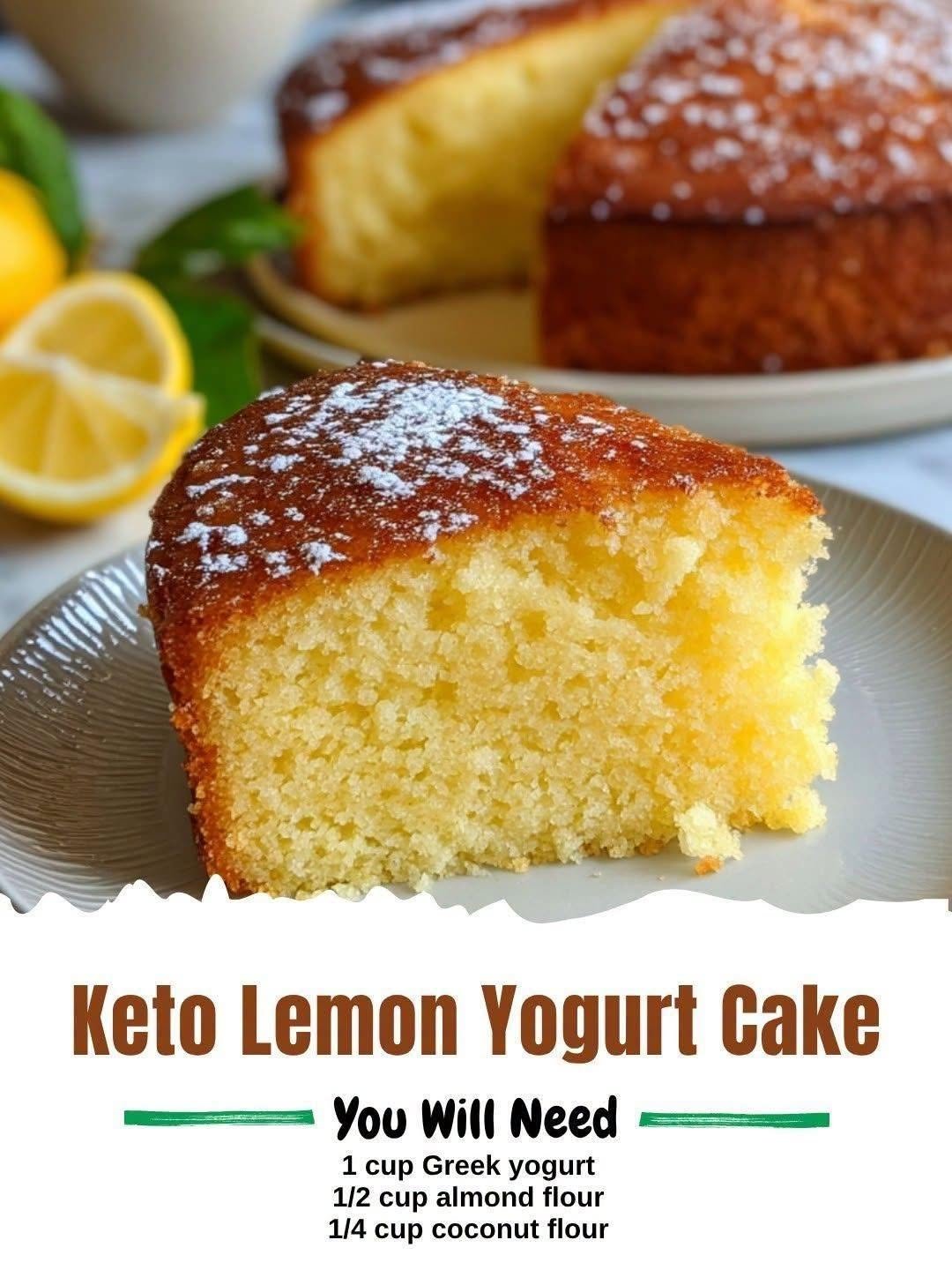
How to Get the Cake in the Picture
For the dense-but-moist appearance shown in your photo:
Use full-fat Greek yogurt.
Use finely ground/blanched almond flour.
Don’t replace coconut flour with an equal volume of almond flour.
Don’t overmix the batter.
Bake until the center is actually set.
Cool completely before cutting.
Use a serrated knife and gentle sawing motions.
For the cleanest slices, refrigerate the cooled cake for 1–2 hours before cutting.
One published keto lemon-yogurt recipe specifically recommends super-fine blanched almond flour for the best texture.
Nut & Allergy Information
Contains nuts
Yes. This recipe contains almonds because of the almond flour.
Contains coconut?
Yes. Coconut flour is used.
Technically, coconut is classified differently from tree nuts in many food-allergen systems, but people with coconut allergies should still avoid it.
Contains dairy?
Yes.
Greek yogurt and butter are dairy products.
Contains eggs?
Yes.
There are 3 eggs.
Gluten-free?
Yes, provided all packaged ingredients are certified gluten-free and there is no cross-contamination.
Almond flour and coconut flour are naturally gluten-free.
Wheat-free?
Yes, assuming your baking powder, sweetener and other packaged ingredients are wheat-free.
Peanut-free?
The recipe itself contains no peanuts, but check your almond flour and other packaged ingredients if you have a severe peanut allergy because of possible shared-facility warnings.
Soy-free?
The basic recipe contains no intentional soy, but check the labels of your butter, yogurt, sweetener and baking powder if you need strict soy avoidance.
Approximate Nutrition
Nutrition varies considerably according to the particular almond flour, yogurt and sweetener used.
For 12 slices, a reasonable estimate for the cake without glaze is approximately:
Nutrient Per slice
Calories ~180–200 kcal
Fat ~14–16 g
Protein ~6–8 g
Total carbs ~6–8 g
Fiber ~2–3 g
Net carbs ~3–5 g
Sugar ~1–2 g
As a comparison, a published keto yogurt cake using almond/coconut flour reports about 188 calories, 6 g carbohydrates, 4 g fiber, 7 g protein and 16 g fat per serving.
Important: erythritol generally contributes little or no usable carbohydrate, but nutrition labels and different sweetener blends can vary. If you’re strictly tracking keto macros, calculate using the exact brands you use.
Why Both Almond Flour and Coconut Flour?
They behave very differently.
Almond flour
Provides:
Moisture
Fat
Rich flavor
Tender crumb
Nutty flavor
Coconut flour
Provides:
Structure
Absorption
A lighter texture
Lower carbohydrate contribution
Don’t substitute them 1:1.
Coconut flour is extremely absorbent. A recipe using ¼ cup coconut flour cannot normally be converted to ¼ cup almond flour without changing the liquid and other ingredients.
Q&A
Q: Can I make this without coconut flour?
Yes, but don’t simply replace it with the same amount.
For an almond-flour-only version, use approximately ¾ cup almond flour total in this particular small-batch formula and watch the batter consistency. A tested almond-flour keto yogurt cake can also use considerably more almond flour depending on the pan and quantities.
Q: Can I use almond meal?
You can, but the cake will generally be heavier and have a more noticeable almond texture.
Super-fine blanched almond flour gives a smoother crumb.
Q: Can I use nonfat Greek yogurt?
Yes, but full-fat yogurt generally gives a richer, more tender result.
Q: Can I use regular plain yogurt?
Yes, but Greek yogurt is thicker. If using thin regular yogurt, the batter may become looser and the baking time may change.
Q: Can I use sour cream?
Yes. Sour cream can replace Greek yogurt at approximately 1:1 by weight, producing a rich, tangy cake.
Q: Can I use allulose instead of erythritol?
Yes. Allulose generally produces a softer/moister texture and browns more readily. Keep an eye on the cake near the end of baking.
Q: Can I use stevia?
Pure stevia isn’t a direct volume-for-volume substitute for erythritol because it’s much sweeter.
Use a granulated 1:1 keto baking sweetener instead.
Q: Can I use monk fruit?
Yes, provided it’s a granulated monk-fruit blend intended to replace sugar 1:1. Check whether the blend contains erythritol, allulose or another bulking ingredient.
Q: Why is my cake dry?
The most likely causes are:
Too much coconut flour
Overbaking
Too little yogurt
Measuring flour by volume inaccurately
Using a very dry yogurt
Coconut flour is particularly absorbent, so even a small quantity difference can noticeably change the texture.
Q: Why is the center wet?
It may simply need more baking time.
Almond-flour cakes retain moisture longer than conventional wheat cakes. Continue baking until the center is set.
Also allow the cake to cool completely before judging its final texture.
Q: Why did my cake sink?
Common reasons include:
Underbaking
Opening the oven too early
Excess liquid
Overmixing
Too much leavening
Cutting while still hot
Q: Can I make cupcakes?
Yes.
Divide the batter among approximately 10–12 lined muffin cups.
Bake at 350°F/175°C and begin checking around 18–25 minutes.
Q: Can I make this in a round cake pan?
Yes. An 8-inch round pan works well, although the baking time will be shorter than for a loaf. Start checking early.
Q: Can I freeze it?
Yes.
Cool completely, slice, and wrap individual portions tightly.
Freeze for up to about 2–3 months for best quality. A comparable keto lemon-yogurt cake recommends freezing the loaf or individual slices for up to three months.
Thaw in the refrigerator and bring to room temperature before serving.
Q: How long does it last?
Because it contains yogurt and eggs, refrigeration is the safest choice for longer storage.
Store in an airtight container in the refrigerator for approximately 4–5 days.
Q: Can I make it more lemony?
Absolutely.
For a stronger lemon flavor, use:
Zest of 2–3 lemons
Up to 3 tablespoons fresh lemon juice
Lemon glaze on top
The zest is especially important because much of the lemon’s aromatic oil is concentrated in the peel.
Q: Is lemon juice keto?
Fresh lemon juice contains some carbohydrate, but the small amount used throughout this cake contributes relatively little carbohydrate per serving.
Q: Is this actually keto?
It is designed to be low-carb/keto-friendly, but whether it fits your individual ketogenic carbohydrate target depends on your portion size and exact ingredients.
For strict keto tracking, calculate the nutrition using the labels of your specific yogurt, almond flour, coconut flour and sweetener.
Best Version for the Texture in Your Photo
If your goal is that golden, moist, fine-crumb cake shown in the picture, I’d use:
Full-fat Greek yogurt + finely ground blanched almond flour + coconut flour + erythritol/allulose blend + fresh lemon zest + melted butter.
Don’t skimp on the lemon zest, and don’t overbake it. The published recipes using this general combination consistently emphasize yogurt for moisture and almond/coconut flour for the low-carb structure.
One important note about the image
The visible text in your image says only:
1 cup Greek yogurt
½ cup almond flour
¼ cup coconut flour

With years of experience in restaurant research and local SEO, Sara creates accurate, user-friendly guides that work for both people and search engines. Her goal is to help users go from search results to their nearest restaurant or menu choice with as few clicks as possible.
- Stuffed Cabbage Rolls - October 18, 2026
- Easy Crockpot Creamy Garlic Parmesan Chicken - October 18, 2026
- Turmeric Carrot Lentil Stew - October 18, 2026