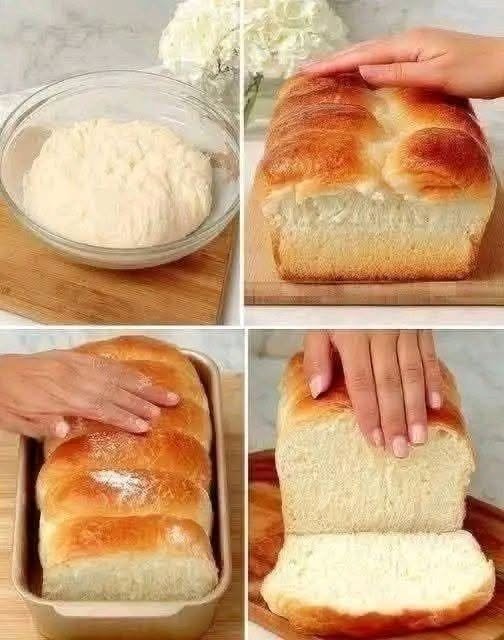
The bread in your photo looks like Japanese-style milk bread / Hokkaido shokupan: a very soft, fluffy loaf with a fine, cotton-like crumb. The characteristic softness comes from tangzhong, a cooked flour-and-liquid paste that lets the dough hold more moisture.
E
Elaine Zhang, Dietitian
+1
Below is a reliable 1 large loaf recipe, designed to give the soft, pull-apart texture shown in your picture.
Recipe at a glance
Yield: 1 large loaf
Pan: 9 × 5-inch loaf pan
Prep: 30–40 minutes
First rise: 60–90 minutes
Second rise: 40–60 minutes
Bake: 28–35 minutes
Total: about 3–4 hours
Oven: 175°C / 350°F
Texture: extremely soft, fluffy and slightly sweet
1. Ingredients
Tangzhong
Ingredient Amount
Bread flour 20 g
Whole milk 100 g/ml
Main dough
Ingredient Amount
Bread flour 300 g
Granulated sugar 45 g
Instant yeast 6 g
Fine salt 5 g
Whole milk 120 g/ml
Large egg 1 / about 50 g
Unsalted butter, softened 40 g
Milk powder 15 g optional
Milk powder gives a richer, milkier flavor, but the loaf works without it. Similar milk-bread formulas use bread flour, milk, egg, butter and tangzhong to create the characteristic soft crumb.
S
See Me Cook
+1
For the top
1 egg yolk
1 tablespoon milk
OR, for a softer matte top:
Brush the baked loaf with a little melted butter.
2. Make the Tangzhong
This is the most important step for the texture in your photograph.
Put 20 g flour + 100 g milk into a small saucepan.
Whisk thoroughly while cold so there are no lumps.
Put over low to medium-low heat.
Stir continuously.
After several minutes it will become a thick, smooth paste.
When it resembles a thick pudding or roux, remove from the heat.
Transfer to a bowl.
Cover with plastic wrap touching the surface.
Allow it to cool until lukewarm or room temperature.
Don’t add very hot tangzhong to the dough because excessive heat can damage the yeast.
The purpose of tangzhong is to pre-gelatinize some of the flour starch, allowing the dough to retain more moisture and producing a softer loaf.
T
The Scranline
+1
3. Make the dough
Step 1 — Combine dry ingredients
In a large bowl combine:
300 g bread flour
45 g sugar
15 g milk powder
6 g instant yeast
5 g salt
Keep the salt from sitting directly on a large amount of yeast before mixing.
Step 2 — Add liquids
Add:
cooled tangzhong
120 g milk
1 egg
Mix until a rough, sticky dough forms.
Don’t immediately add extra flour. The dough is supposed to be soft.
4. Knead
Knead by hand for approximately 10–15 minutes, or use a stand mixer with a dough hook.
Once the dough begins developing gluten:
Add the softened butter gradually.
Knead until the butter disappears.
Continue kneading until the dough becomes smooth, elastic and stretchy.
The windowpane test
Take a small piece of dough and gently stretch it.
If you can stretch it into a thin membrane without it immediately tearing, the gluten is sufficiently developed.
This step is one of the keys to getting the tall, fluffy structure seen in your image.
5. First proof
Place the dough into a lightly greased bowl.
Cover.
Leave somewhere warm for approximately 60–90 minutes, or until roughly doubled in size.
Ideal temperature
Approximately 25–28°C is comfortable for proofing.
Don’t rely exclusively on the clock. Temperature, yeast activity and flour can change the timing.
The dough should look noticeably expanded and airy.
6. Divide and shape
For the classic pull-apart appearance shown in your photo:
Remove the dough from the bowl.
Gently press out excessive gas.
Divide into 3 equal pieces.
Shape each piece into a ball.
Rest for 10–15 minutes.
Then shape each piece:
Flatten one dough ball into an oval.
Fold the left side toward the center.
Fold the right side toward the center.
Roll it gently into a short cylinder.
Place the three pieces side-by-side in a greased loaf pan.
This three-piece method helps create the characteristic rounded sections on top.
7. Second proof
Cover the pan loosely.
Let the dough rise for approximately 40–60 minutes.
The dough should become visibly puffy and approach the top of the pan.
Important
Do not wait until it has dramatically overflowed the pan.
Over-proofed milk bread can collapse or develop a weak, coarse crumb.
8. Egg wash
Mix:
1 egg yolk
1 tablespoon milk
Gently brush the exposed dough.
Don’t press down hard with the brush because you can deflate the risen dough.
This produces the beautiful golden-brown surface visible in your picture.
9. Bake
Preheat oven to:
175°C / 350°F
Bake for approximately:
28–35 minutes
The exact time depends on your oven and pan.
If the top becomes dark too quickly, loosely cover it with aluminum foil during the latter part of baking.
A bread thermometer is useful: a fully baked enriched loaf is around 93°C / 200°F internally. One current milk-bread formula similarly uses about 200°F as the internal target.
S
See Me Cook
10. Cooling
Immediately remove the bread from the pan.
Place it on a wire rack.
Allow it to cool for at least 45–60 minutes before slicing.
Don’t cut it immediately!
The crumb is still setting while hot. Cutting too soon can make the interior appear gummy or compressed.
For the exceptionally soft texture in your picture, gently tear the bread apart once it has cooled rather than pressing a knife through it.
Optional: Extra-soft butter finish
For an especially soft crust:
Immediately after baking, brush the top with:
1–2 teaspoons melted butter
This gives a softer, buttery crust rather than a firm shiny crust.
Baker’s percentages
If you like professional bread formulas, this is approximately:
Flour: 100%
Milk: ~55%
Sugar: 14%
Butter: 12.5%
Egg: ~15–17%
Yeast: 2%
Salt: 1.6%
The tangzhong is included separately because some of the flour and milk are pre-cooked.
Nut / Allergen Information
If by “nut info” you mean whether the recipe contains nuts:
Naturally nut-free ingredients
The basic recipe contains no peanuts, almonds, walnuts, cashews, pistachios, hazelnuts, pecans, etc.
However, if this is being prepared for someone with a nut allergy, check the labels of:
flour
milk powder
butter
yeast
any toppings
chocolate or spreads, if added
Manufacturers can process products in facilities that also handle nuts.
Major allergens in this recipe
It contains:
Wheat/gluten
Milk/dairy
Egg
So this is not gluten-free, dairy-free, or egg-free.
Approximate nutrition
For the whole loaf, using the ingredients above, the recipe is roughly:
Calories: ~2,050–2,200 kcal
Protein: ~60–65 g
Carbohydrates: ~330–350 g
Fat: ~55–60 g
Sugar: ~45–50 g
If cut into 12 slices, that’s approximately:
170–185 kcal per slice
5 g protein
28–29 g carbohydrate
5 g fat
These are estimates rather than laboratory nutrition values; flour, milk, butter and slice size can change the numbers.
Frequently Asked Questions
Q1. Can I use all-purpose flour?
Yes, but bread flour is preferable.
Bread flour generally gives this loaf better gluten development and a stretchy, fluffy structure. If your all-purpose flour is relatively high in protein, it can work very well.
Q2. Can I use instant yeast?
Yes. That’s what this recipe uses.
If using active dry yeast instead, proofing may take somewhat longer.
Q3. Can I use fresh yeast?
Yes.
As a rough conversion, 6 g instant yeast ≈ 18 g fresh yeast.
Q4. Can I make it without tangzhong?
Yes, but I wouldn’t recommend it if you’re specifically trying to reproduce the texture in your photo.
Tangzhong is one of the major techniques responsible for the moist, pillowy crumb.
E
Elaine Zhang, Dietitian
+1
Q5. Can I use water instead of milk?
Yes, but milk gives a richer flavor and softer, more tender result.
A water-based tangzhong is also commonly used in milk-bread formulas.
N
Naomi\’s Recipes
+1
Q6. Can I use low-fat milk?
Yes.
Whole milk gives the richest result, but 2% milk can work.
Q7. Why is my dough sticky?
Milk bread dough is naturally soft and somewhat sticky.
Don’t keep adding flour.
Instead, knead longer. As gluten develops, the dough should become smoother and more elastic.
Adding too much flour is one of the easiest ways to turn this bread from fluffy to dense.
Q8. Why didn’t my bread rise?
Possible causes:
expired/inactive yeast
milk or tangzhong was too hot
room was too cold
insufficient kneading
too much flour
insufficient proofing time
Check the dough rather than following the clock rigidly.
Q9. Why did my bread collapse?
Usually one of these:
over-proofing
insufficient gluten development
dough was too wet
underbaking
opening the oven repeatedly during baking
Q10. Why is my bread dense?
The most common causes are:
under-kneading + under-proofing + too much flour.
The dough should become elastic before shaping.
Q11. Why is the crust darker than the bread in the picture?
Your oven may run hot, or the egg wash may be producing more browning.
Try 170°C / 340°F and bake slightly longer, or cover the top loosely with foil once it reaches your preferred color.
Q12. Can I make this without egg?
Yes.
Replace the egg with approximately 45–50 g additional milk, adding it gradually because dough hydration varies.
The result will be somewhat different in richness and structure.
Q13. Can I make it dairy-free?
Yes, although the flavor and texture will change.
Use:
unsweetened soy/oat milk
plant-based butter
For a dairy-free version, choose products specifically labeled according to your allergy requirements.
Q14. Can I make it sweeter?
Yes.
Increase sugar from 45 g to 55–65 g.
Don’t dramatically increase it, because higher sugar levels can slow yeast activity.
Q15. Can I make dinner rolls with this dough?
Absolutely.
Instead of one loaf, divide into 8–12 pieces, shape into balls, place in a baking dish, proof, egg-wash and bake.
Tangzhong milk-bread dough is also commonly used for very soft rolls.
K
King Arthur Baking
Q16. How do I store it?
Once completely cool:
Q13. Can I make it dairy-free?
Yes, although the flavor and texture will change.
Use:
Put it in an airtight bag/container.
Keep at room temperature.
Avoid refrigerating unless necessary.
Refrigeration tends to make bread stale faster.
For longer storage, freeze it.
Q17. Can I freeze the bread?
Yes.
Cool completely, slice if desired, wrap tightly and freeze.
Individual slices can be taken out as needed and gently warmed or toasted.
Q18. Why is my bread soft on day one but dry the next day?
Usually because of:
Q17. Can I freeze the bread?
overbaking
insufficient hydration
excessive flour
inadequate storage
Tangzhong helps retain moisture, which is why it is particularly useful for this style of bread.
F
Food Network
+1
The 7 secrets to getting the exact fluffy texture
1. Weigh the flour.
Don’t keep adding flour until the dough feels like ordinary bread dough.
2. Don’t skip tangzhong.
3. Knead until you get a windowpane.
4. Let the first rise actually develop.
5. Don’t over-proof the second rise.
6. Don’t overbake.
7. Cool completely before cutting.
Those points matter more than adding lots of extra butter or sugar.
For the bread in your photograph
I’d use bread flour + whole milk + tangzhong + egg + butter + three-piece shaping + egg wash. That combination is particularly suited to the tall, golden, extremely soft loaf shown in the image. Comparable published milk-bread recipes use the same core

With years of experience in restaurant research and local SEO, Sara creates accurate, user-friendly guides that work for both people and search engines. Her goal is to help users go from search results to their nearest restaurant or menu choice with as few clicks as possible.
- Grandma’s Cream Puffs – Light, Crisp & Creamy - October 17, 2026
- Easy Crockpot Creamy Garlic Parmesan Chicken - October 17, 2026
- Garlic Herb Roasted Potatoes - October 17, 2026