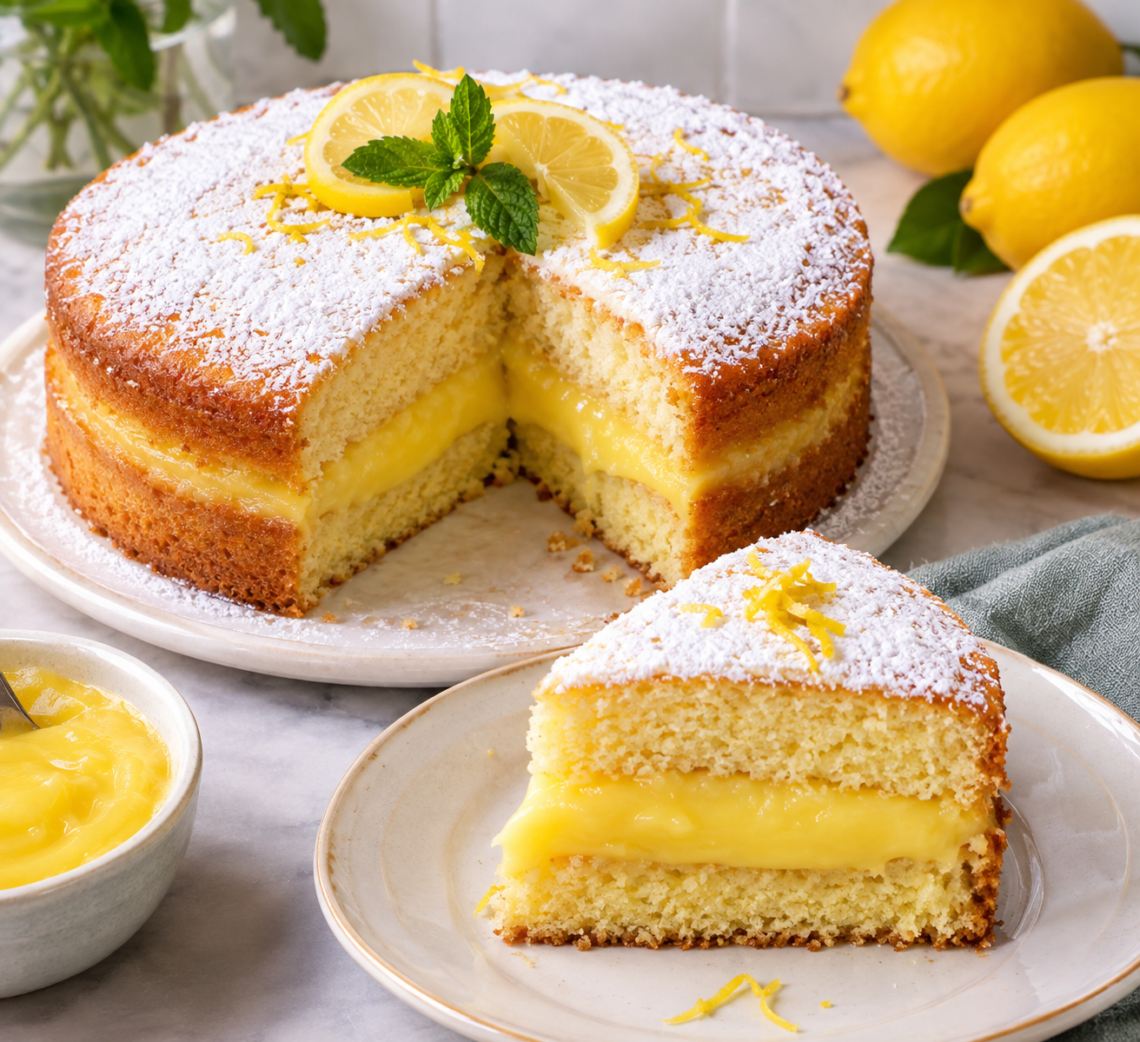
This Sugar-Free Lemon Custard Cake has a soft, delicate cake layer on top and a smooth, creamy lemon custard layer underneath. It uses almond flour and a baking-friendly sugar substitute instead of regular sugar. The separated eggs help create the light cake-and-custard texture.
Prep Time: 20 minutes
Cook Time: 50–55 minutes
Chilling Time: 2 hours
Total Time: About 3 hours 15 minutes
Servings: 9 squares
Pan: 8 × 8-inch baking pan
Oven: 325°F (165°C)
Ingredients
For the Almond Crust
1 1/2 cups (150 g) finely ground almond flour
3 tablespoons unsalted butter, melted
2 tablespoons granulated sugar-free sweetener
Pinch of salt
For the Lemon Custard Cake
4 large eggs, separated and brought to room temperature
1/2 cup granulated sugar-free sweetener, such as erythritol, monk fruit blend, or allulose
1/2 cup (113 g) unsalted butter, melted and cooled
1 teaspoon vanilla extract
1 tablespoon finely grated fresh lemon zest
1/3 cup (80 ml) fresh lemon juice
1 cup (100 g) finely ground almond flour
1 1/2 cups (360 ml) unsweetened almond milk
Pinch of salt
Optional Topping
2–3 tablespoons powdered sugar-free sweetener
Thin lemon slices
Fresh lemon zest
Fresh mint leaves
Instructions
Preheat the oven to 325°F (165°C). Line an 8 × 8-inch baking pan with parchment paper, leaving some paper hanging over the sides so the cake can be lifted out easily.
Make the crust. Add the almond flour, melted butter, sugar-free sweetener and salt to a bowl. Mix until the ingredients are evenly combined and the mixture resembles moist crumbs.
Press the crust firmly and evenly into the bottom of the prepared pan. Use the bottom of a glass or measuring cup to compact it.
Bake the crust for 8–10 minutes, just until lightly golden. Remove from the oven and allow it to cool slightly.
Separate the eggs carefully. Put the yolks in one large bowl and the whites in a completely clean, dry bowl. Even a small amount of yolk in the whites can make them difficult to whip properly.
Add the granulated sugar-free sweetener to the egg yolks. Beat for 2–3 minutes until the mixture becomes lighter in color and slightly thickened.
Slowly whisk in the melted and cooled butter. Add the vanilla extract, lemon zest and fresh lemon juice. Mix until smooth.
Add the almond flour and salt. Stir gently until combined.
Gradually whisk in the unsweetened almond milk. The batter will become quite thin. This is normal and is important for creating the custard layer.
In a separate clean bowl, beat the egg whites until soft peaks form. Do not overbeat them until they become dry.
Gently fold the whipped egg whites into the lemon batter in 2–3 additions. Fold slowly and carefully so you retain some of the air from the egg whites. The batter does not need to look completely uniform.
Pour the batter over the partially cooled crust.
Bake at 325°F (165°C) for approximately 45–55 minutes. The top should be lightly golden and set, while the center should still have a gentle wobble when the pan is moved. Do not overbake because the custard will continue setting as it cools.
Remove the cake from the oven and allow it to cool completely in the pan.
Cover and refrigerate for at least 2 hours. Chilling allows the custard layer to firm up and makes the cake much easier to cut cleanly.
Lift the cake out using the parchment paper. Dust lightly with powdered sugar-free sweetener and decorate with lemon slices, fresh lemon zest or mint if desired.
Cut into 9 squares and serve chilled.
Nutrition Information
Approximate per 1 square, based on 9 servings:
Calories: 225 kcal
Protein: 8 g
Total Carbohydrates: 7 g
Fiber: 3 g
Net Carbohydrates: About 4 g
Fat: 19 g
Saturated Fat: About 7–8 g
Sugar: About 2–3 g naturally occurring
Added Sugar: 0 g
Sodium: Approximately 100–150 mg
Nutrition can vary depending on the almond flour, almond milk, butter and sugar-free sweetener used. A published version of this style of cake lists approximately 225 calories, 19 g fat, 7 g carbohydrates, 3 g fiber and 8 g protein per serving.
Allergen Information
Contains: Almonds and dairy.
Gluten-Free: Yes, when using certified gluten-free ingredients.
Wheat-Free: Yes.
Nut-Free: No. Almond flour and almond milk are used.
Peanut-Free: Yes, provided all packaged ingredients are produced in a peanut-free facility.
Dairy-Free: No. Butter is used. For a dairy-free version, use a suitable dairy-free butter alternative.
Egg-Free: No.
Soy-Free: Usually yes, but check the labels of your butter, almond milk and sweetener.
Vegetarian: Yes.
Vegan: No, because the recipe contains eggs and butter.
Important Note About “Sugar-Free”
This recipe contains no regular table sugar or added refined sugar. However, lemons and unsweetened almond milk can contain small amounts of naturally occurring carbohydrates and sugars. The exact amount depends on the ingredients used.
Tips for the Best Lemon Custard Cake
Use fresh lemons. Freshly grated zest and freshly squeezed juice give the strongest lemon flavor.
Use finely ground almond flour rather than coarse almond meal. Fine almond flour produces a more delicate texture.
Room-temperature eggs whip more easily and help create a lighter top layer.
Do not skip separating the eggs. The whipped egg whites are important for creating the characteristic light cake layer above the custard.
Do not overmix after adding the whipped egg whites. Gentle folding helps preserve the air.
Do not overbake. The center should have a slight wobble when the cake comes out of the oven. It will become firmer during cooling and refrigeration.
For the cleanest slices, refrigerate the cake for at least 2 hours before cutting.
If using erythritol, powdered erythritol can be used for the topping. Allulose or monk-fruit-based baking blends can also work, although sweetness and texture may vary between brands.
Storage
Store the cake covered in the refrigerator for up to 4 days.
For the best texture, serve it chilled.
The untopped cake can be frozen for up to about 2 months. Thaw it overnight in the refrigerator before serving.
Q&A
Q: Why does this cake have two layers?
A: The thin batter and whipped egg whites naturally separate during baking. The lighter portion rises to form a tender cake layer while the heavier portion settles underneath and forms the creamy lemon custard.
Q: Can I use regular milk instead of almond milk?
A: Yes. Regular milk can be used, but it will change the nutritional information and may slightly change the flavor and texture.
Q: Can I use coconut flour instead of almond flour?
A: Not as a direct 1:1 replacement. Coconut flour absorbs considerably more liquid, so the recipe would need to be reformulated.
Q: Can I use monk fruit sweetener?
A: Yes. A granulated monk-fruit baking blend can be used, but check whether your particular product measures cup-for-cup like sugar because sweetness varies between brands.
Q: Can I use allulose?
A: Yes. Allulose is another option for sugar-free baking, although it can brown differently from erythritol and may produce a somewhat softer texture.
Q: Why is my custard cake watery?
A: It may need additional chilling, or it may have been underbaked. Make sure the center has only a gentle wobble rather than appearing liquid when the cake comes out of the oven.
Q: Why didn’t my cake develop a clear custard layer?
A: Overmixing the whipped egg whites, changing the proportions of the ingredients, or using a substantially different pan size can affect the separation.
Q: Can I make it more lemony?
A: Yes. Add another 1–2 teaspoons of finely grated lemon zest. You can also add a small amount of natural lemon extract for a stronger lemon aroma.
Q: Can I make this cake without the crust?
A: Yes. You can bake the batter directly in a parchment-lined pan, but the finished dessert will have a softer bottom rather than the buttery almond crust.
Q: Is this cake keto?
A: It can fit into many low-carb or keto-style diets when a suitable low-carb sweetener and unsweetened almond milk are used, but the exact carbohydrate count depends on the ingredients and serving size.
Q: Can I make this cake ahead of time?
A: Yes. In fact, it is better when made ahead because refrigeration gives the custard time to fully set. Making it several hours before serving is recommended.

With years of experience in restaurant research and local SEO, Sara creates accurate, user-friendly guides that work for both people and search engines. Her goal is to help users go from search results to their nearest restaurant or menu choice with as few clicks as possible.
- Grandma’s Cream Puffs – Light, Crisp & Creamy - October 17, 2026
- Easy Crockpot Creamy Garlic Parmesan Chicken - October 17, 2026
- Garlic Herb Roasted Potatoes - October 17, 2026