Serves: 6
Prep time: 25–30 minutes
Roasting time: 60–75 minutes
Total: about 1½ hours
Oven: 400°F / 200°C
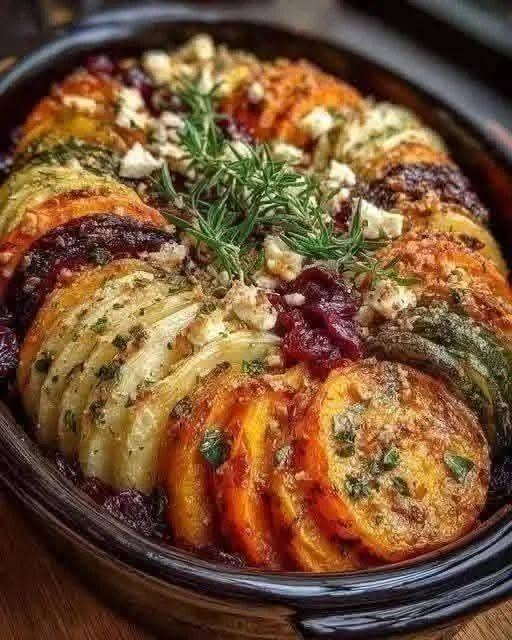
The recipe below is designed to reproduce the colorful, fan-shaped appearance in your photograph rather than claiming the photo came from a particular recipe.
Ingredients
Vegetables
2 medium sweet potatoes
2 medium Yukon Gold or yellow potatoes
2 medium red beets
1 medium zucchini
1 medium carrot
1 small butternut squash, preferably the solid neck portion
1 small red onion
3–4 garlic cloves
You don’t have to use every vegetable. The most important combination for the appearance is sweet potato + potato + beet + zucchini, with orange/yellow vegetables filling the gaps.
Herb-garlic oil
4 tbsp extra-virgin olive oil
2 tbsp melted butter, optional
3 garlic cloves, finely minced
1 tbsp fresh rosemary, finely chopped
1 tsp fresh thyme leaves
½ tsp dried oregano
½ tsp smoked paprika
½ tsp salt
¼ tsp black pepper
1 tbsp lemon juice
1 tsp honey or maple syrup, optional
Topping
100–150 g (3½–5 oz) feta cheese, crumbled
1–2 tbsp fresh parsley, chopped
1–2 rosemary sprigs
Optional: 1 tbsp pumpkin seeds or sunflower seeds
Roasted root vegetables pair particularly well with feta and fresh herbs; similar preparations use beetroot, sweet potato, feta, thyme and olive oil.
1. Prepare the vegetables
Wash everything thoroughly.
Peel:
beets
sweet potatoes, if desired
potatoes, if desired
butternut squash
The zucchini can remain unpeeled.
Cut the vegetables into pieces approximately 1½–2 inches / 4–5 cm wide so that they can stand upright in the baking dish.
Important
For Hasselback slices, you want thin, even slices about ⅛ inch / 3 mm apart, but don’t cut completely through the vegetable.
The easiest technique is to put the vegetable between two wooden chopsticks or the handles of two wooden spoons. Slice downward until the knife hits the spoons.
This keeps the base intact and creates the characteristic accordion/fan effect.
2. Hasselback the vegetables
Make closely spaced cuts across:
potatoes
sweet potatoes
zucchini
carrots
butternut squash
For the beetroot, use a particularly sharp knife because it can be harder and more slippery.
Beetroot tip
Beets can bleed their color into everything around them. For a cleaner presentation, roast them separately for part of the cooking process or place them toward one side of the dish. This is also recommended in Hasselback root-vegetable preparations because purple vegetables can color neighboring vegetables.
3. Make the herb-garlic oil
Add to a small bowl:
olive oil
melted butter, if using
garlic
rosemary
thyme
oregano
smoked paprika
salt
pepper
lemon juice
honey/maple syrup
Whisk thoroughly.
Taste it.
It should be savory, garlicky, herby and slightly acidic, with just enough sweetness to complement the roasted root vegetables.
4. Coat the vegetables
Brush the herb oil generously over each vegetable.
Try to get some oil between the slices.
Don’t worry if the slices aren’t completely separated—the oven will open them naturally as the vegetables soften.
Keep about 1 tablespoon of the herb oil for later.
5. Arrange the casserole
Choose a heavy round baking dish, cast-iron skillet or ceramic casserole.
Lightly oil the bottom.
Arrange the vegetables upright in a circular pattern.
For the appearance in your photograph, alternate colors:
potato → beet → sweet potato → zucchini → carrot → squash
and repeat.
Place the red onion and garlic between the vegetables.
The vegetables should fit snugly but not be compressed.
The tight arrangement helps them roast into a cohesive casserole while retaining the dramatic fan shape.
6. First roast
Cover the dish loosely with aluminum foil.
Bake at:
400°F / 200°C for 30 minutes.
The covered stage allows the dense vegetables to steam/roast and begin softening.
7. Uncover and continue roasting
Remove the foil.
Brush the remaining herb oil over the vegetables.
Return the dish to the oven for another:
30–40 minutes.
The vegetables should become:
tender inside
browned around the edges
caramelized on the exposed slices
slightly crisp on top
General roasted-root-vegetable recipes commonly use around 200°C/400°F and roughly 40–50 minutes, while denser whole or larger beetroot pieces can require longer.
8. Add the feta
When the vegetables are almost completely tender, remove the dish.
Scatter the crumbled feta over the top.
Return to the oven for another 5–8 minutes.
You want the feta warmed and lightly browned, rather than completely melted.
For a more dramatic golden top, place the casserole under the broiler/grill for 1–2 minutes.
Watch it continuously.
9. Finish
Remove from the oven.
Sprinkle with:
fresh parsley
fresh rosemary
fresh thyme
black pepper
Optional:
toasted pumpkin seeds
sunflower seeds
a drizzle of extra-virgin olive oil
a little lemon juice
Let it rest for 5–10 minutes before serving.
Secret to the Beautiful Appearance
The photograph has a particularly attractive alternating-color effect.
For that presentation:
Use approximately:
25% orange: sweet potato/carrot
25% yellow: potato/butternut squash
20% red/purple: beet
20% green: zucchini
10% white: onion/garlic
Then arrange them in repeating color groups.
The contrast between orange, purple, green and yellow becomes much more dramatic after roasting.
Optional Lemon-Herb Drizzle
This makes the finished dish taste fresher.
Mix:
2 tbsp extra-virgin olive oil
1 tbsp lemon juice
1 tsp Dijon mustard
1 small garlic clove, grated
1 tbsp chopped parsley
pinch of salt
black pepper
Whisk until emulsified.
Drizzle lightly over the finished vegetables.
A lemon-and-herb dressing is also commonly used with roasted root vegetables and helps balance their sweetness.
Flavor Variations
Mediterranean
Use:
oregano
thyme
garlic
feta
lemon
parsley
Middle Eastern
Replace the herb mixture with:
1 tsp cumin
1 tsp coriander
½ tsp smoked paprika
½ tsp cinnamon
pinch of chili
lemon
Baharat or similar warm spice blends work particularly well with roasted sweet potato and beetroot.
Holiday version
Add:
cranberries
feta
rosemary
toasted pumpkin seeds
maple syrup
Vegan
Simply omit the feta and butter and use olive oil. The vegetables themselves are vegan.
Nut Information
As written: nut-free
There are no peanuts or tree nuts in the basic recipe.
That means no:
almonds
walnuts
cashews
pecans
pistachios
hazelnuts
macadamias
Brazil nuts
A similar roasted-root-vegetable recipe is specifically identified as free from nuts, while other versions add mixed nuts or seeds as an optional topping—so the topping is the part to watch carefully.
Safe nut-free topping choices
If you’re cooking for someone with a nut allergy, use:
pumpkin seeds
sunflower seeds
sesame seeds, if sesame is tolerated
Or simply leave the seeds off.
Allergy warning
For a serious nut allergy, check packaged:
feta
butter
spice mixes
seeds
vegetable stock, if used
for manufacturer allergen statements and cross-contact warnings.
Other Allergens
Dairy
Yes, if using:
butter
feta
For dairy-free preparation, use olive oil and omit feta or substitute a suitable dairy-free feta.
Gluten
The basic recipe is naturally gluten-free, assuming all packaged seasonings are gluten-free.
Eggs
None.
Soy
None intentionally added.
Sesame
None unless you use sesame seeds.
Approximate Nutrition
For 1 of 6 servings, without optional seeds:
Calories: ~280–340 kcal
Protein: ~7–9 g
Carbohydrates: ~40–45 g
Fiber: ~7–9 g
Fat: ~12–15 g
Saturated fat: ~4–5 g
Sodium: ~450–650 mg
Actual values will depend on the exact vegetables, amount of oil and quantity of feta.
For comparison, a roasted root-vegetable tray bake with potatoes, mixed roots, feta and nuts has been reported at about 485 kcal and 9 g fiber per serving, although that version contains substantially more oil and nuts than the recipe above.
Recipe Q&A
Q: What vegetables are actually in the photograph?
The image appears to feature a mixture of sweet potato, potato, beetroot and green/yellow vegetables, arranged Hasselback-style. Because the photo alone cannot establish the exact ingredients, the recipe above is an image-inspired version.
Q: Do I have to use beets?
No. Replace them with red potatoes, purple sweet potatoes, carrots or red onions.
Q: Why are my vegetables still hard?
The most likely reason is that the pieces are too thick.
Cut them to approximately 3 mm slices and cover the dish during the first stage of cooking.
Q: Why are my vegetables watery?
Zucchini and beets can release considerable moisture.
Don’t overcrowd the dish excessively, and avoid adding extra liquid to the bottom.
Q: Why did everything turn purple?
Beets release their natural pigments during roasting. Keep beetroot pieces separated from pale vegetables if you want distinct colors.
Q: Can I use only root vegetables?
Absolutely.
Try:
potato
sweet potato
beet
carrot
parsnip
turnip
rutabaga
A basic roasted-root formula works with many combinations of these vegetables.
Q: Can I prepare it ahead?
Yes. Slice and arrange the vegetables several hours ahead, cover and refrigerate.
Brush with the seasoned oil immediately before roasting.
Q: Can I make it the day before?
Yes, but the vegetables will be softer when reheated.
For the best texture, roast it fresh.
Q: Can I use frozen vegetables?
I wouldn’t recommend frozen vegetables for this particular presentation. They contain more released moisture and won’t hold the Hasselback shape as well.
Q: Can I make this without cheese?
Yes. Simply omit the feta. Increase the herbs and finish with lemon and olive oil.
Q: What cheese works instead of feta?
Good choices include:
goat cheese
Parmesan
pecorino
queso fresco
crumbled blue cheese
For a mild flavor, use feta. For a more intensely savory crust, use Parmesan.
Q: Can I add nuts?
Yes, if allergies aren’t an issue.
Chopped walnuts, pecans or pistachios would provide a nice contrast, but add them only during the final 10 minutes so they don’t burn.
Q: What is the best nut-free crunchy topping?
Pumpkin seeds are excellent, assuming there is no seed allergy. Toast them separately and scatter them over the dish immediately before serving.
Q: Is this a main course or side dish?
It works as either.
As a side, serve it with roasted chicken, salmon, lamb or steak.
As a vegetarian main, increase the feta and serve with chickpeas, lentils, white beans or a yogurt-based sauce. Roasted sweet potato and beetroot with chickpeas and feta is a particularly natural combination.
Q: How do I make it vegan?
Use olive oil instead of butter and omit the feta or use vegan feta.
Q: How do I make it higher in protein?
Serve it with:
chickpeas
lentils
Greek yogurt
grilled chicken
salmon
white beans
Q: Can I make it spicy?
Yes. Add ½–1 tsp chili flakes, cayenne or Aleppo pepper to the herb oil.
Q: What sauce goes best with it?
My top choices are:
Garlic yogurt: Greek yogurt + lemon + garlic + parsley.
Tahini lemon sauce: tahini + lemon + garlic + water + salt.
Herb dressing: olive oil + lemon + parsley + rosemary.
Q: How should I store leftovers?
Cool promptly, refrigerate in a covered container, and reheat until thoroughly hot. The roasted vegetables can also be enjoyed cold or at room temperature.
Q: Can I freeze it?
You can, but I don’t recommend freezing the assembled casserole. Potatoes, zucchini and beets can become softer and release moisture after thawing.
Q: What makes this recipe different from ordinary roasted vegetables?
The Hasselback cuts and upright arrangement are the key. Instead of chopping everything into cubes, the vegetables remain visually intact while the thin cuts expose more surface area to the oil, herbs and heat. This is precisely why the Hasselback technique works beyond potatoes and can be applied to root vegetables.
For the closest result to your photograph: use sweet potato + Yukon Gold potato + beetroot + zucchini, arrange them tightly in alternating colors, coat generously with garlic-rosemary olive oil, roast covered first, then uncovered until deeply caramelized, and finish with crumbled feta and fresh rosemary.

With years of experience in restaurant research and local SEO, Sara creates accurate, user-friendly guides that work for both people and search engines. Her goal is to help users go from search results to their nearest restaurant or menu choice with as few clicks as possible.
- Grandma’s Cream Puffs – Light, Crisp & Creamy - October 17, 2026
- Easy Crockpot Creamy Garlic Parmesan Chicken - October 17, 2026
- Garlic Herb Roasted Potatoes - October 17, 2026